Beetroot
Beta vulgaris subsp. vulgaris
An earthy, deeply coloured root that roasts sweet, pickles well and stains everything it touches.
- Also
- Beet, Red beet, Barbabietola
- Family
- Amaranthaceae (amaranth family)
How to recognise it
In the garden and in the hand.
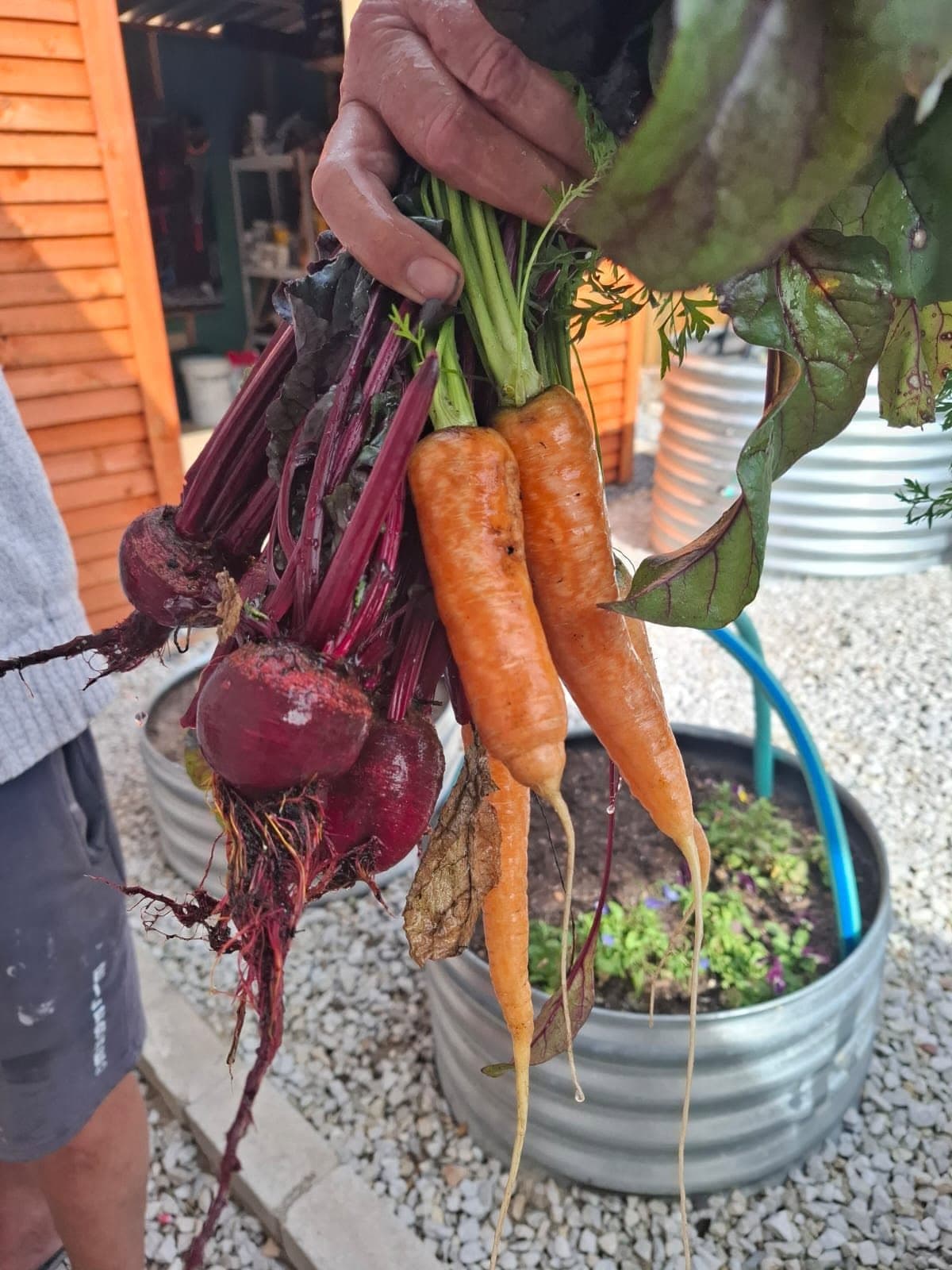
harvestedHarvested: round red roots and red-veined leaves, straight from the soil.
- Growth habit
- A rosette of upright leaves on red-veined stalks above a swollen round root that sits partly out of the soil.
- Leaves
- Glossy, oval to heart-shaped leaves, dark green with red veins and stalks, twenty to forty centimetres tall.
- Stem
- Red or red-striped leaf stalks; a tall branching flower stem only in the second year.
- Flower
- Insignificant green flower clusters if left to bolt.
- Colour
- Deep red-purple roots on most varieties; golden and striped varieties exist.
- Aroma
- Earthy, from the compound geosmin, strongest in the raw root.
- Texture
- Dense, crisp root; tender leaves.
- Distinguishing features
- Red-veined glossy leaves over a round root showing red at the shoulder.
- Common lookalikes
- Chard is the same species grown for leaves and looks like beetroot foliage without the swollen root.
In the garden
Growing and harvest.
- Conditions
- Full sun, loose soil, regular water; sow direct and thin the clusters.
- Season
- Sown from spring to late summer, harvested eight to twelve weeks later; young roots are the sweetest. Seasons vary by region and climate.
- Harvested part
- The root and the young leaves.
- Ready when
- Roots four to eight centimetres across, showing at the soil surface.
In the kitchen
Flavour and use.
- Flavour
- Sweet and earthy, brighter with vinegar or citrus.
- Texture
- Dense and juicy; silky when roasted whole.
- Edible parts
- The root, raw or cooked; the leaves and stalks, cooked like chard.
- Preparations
- Roasted whole in the skin, Boiled and peeled, Grated raw, Pickled, Fermented (kvass), Leaves wilted in oil
- Techniques
- Roasting, Boiling, Pickling, Fermenting, Grating raw
- Pairs with
- Goat's cheese, Horseradish, Orange, Dill, Walnuts, Vinegar
Selection and storage
Choosing, keeping, preserving.
- Choosing
- Firm, smooth roots with fresh leaves if attached; smaller roots are sweeter and less woody.
- Storage
- Twist off the leaves, keep the root refrigerated for two to three weeks; use the leaves within a day or two.
- Preserving
- Pickled in spiced vinegar, fermented in brine, or roasted and frozen.
Traditional uses, nutrition and current evidence
What is known, and how well.
Each statement carries its evidence level in words and a numbered source. Nothing here recommends an ingredient as a treatment.
Nutrition
Traditional use
Traditional use, not clinically established
Grown since antiquity, first for the leaves and later for the root; a staple of Eastern European and Mediterranean cooking rather than a remedy. [1]
Current evidence
Supported by human research
Short-term human trials pooled in a meta-analysis found that dietary nitrate, largely from beetroot juice, lowered blood pressure modestly while it was taken. This is not a treatment for high blood pressure and does not replace medical care. [3]
Safety and cautions
Before you cook with it.
- After eating beetroot, some people pass red or pink urine (beeturia). It is harmless and passes within a day or two.
- The nitrate research concerns juices and concentrated preparations; eating beetroot as a vegetable is ordinary food. Anyone on blood-pressure medication should not use beetroot juice as a substitute for treatment and should discuss large regular intakes with their clinician.
- Beetroot leaves and root contain oxalate; people who have been advised to limit oxalate should include it in that count.
This ingredient profile is provided for culinary and general educational purposes. It is not medical advice and does not recommend an ingredient as a treatment. Anyone who is pregnant, managing a medical condition, allergic, or taking medication should consult an appropriate healthcare professional before using concentrated herbal preparations or supplements.
Elsewhere on DUKAI
Also in the library
Sources and review
- 1USDA FoodData Central, Beets, rawNational food-composition database
- 2National Institutes of Health, Office of Dietary Supplements, Folate fact sheetGovernment health agency
- 3Siervo M, Lara J, Ogbonmwan I, Mathers JC. Inorganic nitrate and beetroot juice supplementation reduces blood pressure in adults: a systematic review and meta-analysis. Journal of Nutrition. 2013;143(6):818-826.Peer-reviewed systematic review and meta-analysis
- 4Mitchell SC. Food idiosyncrasies: beetroot and asparagus. Drug Metabolism and Disposition. 2001;29(4 Pt 2):539-543.Peer-reviewed review
Sources reviewed 9 September 2026. Culinary and general educational information.
Photographs are from Paul Dukai's own archive.