Tomato
Solanum lycopersicum
Botanically a fruit and treated as a vegetable in the kitchen: sweet, sharp and savoury at once, and the backbone of the Italian table.
- Also
- Tomatoes, Pomodoro
- Family
- Solanaceae (nightshade family)
How to recognise it
In the garden and in the hand.
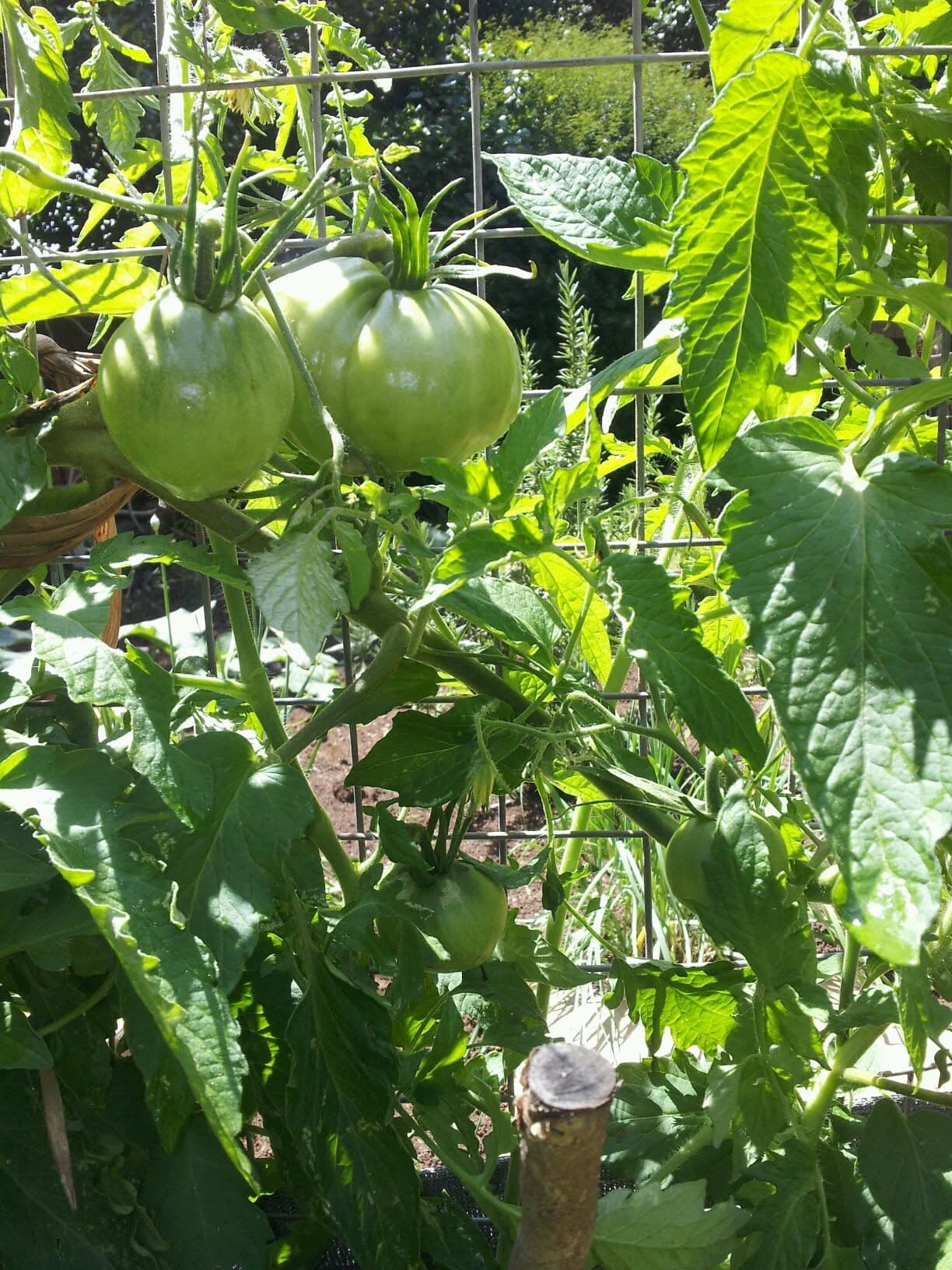
growingThe plant in the garden: green fruit in clusters, compound leaves, soft branching stems. 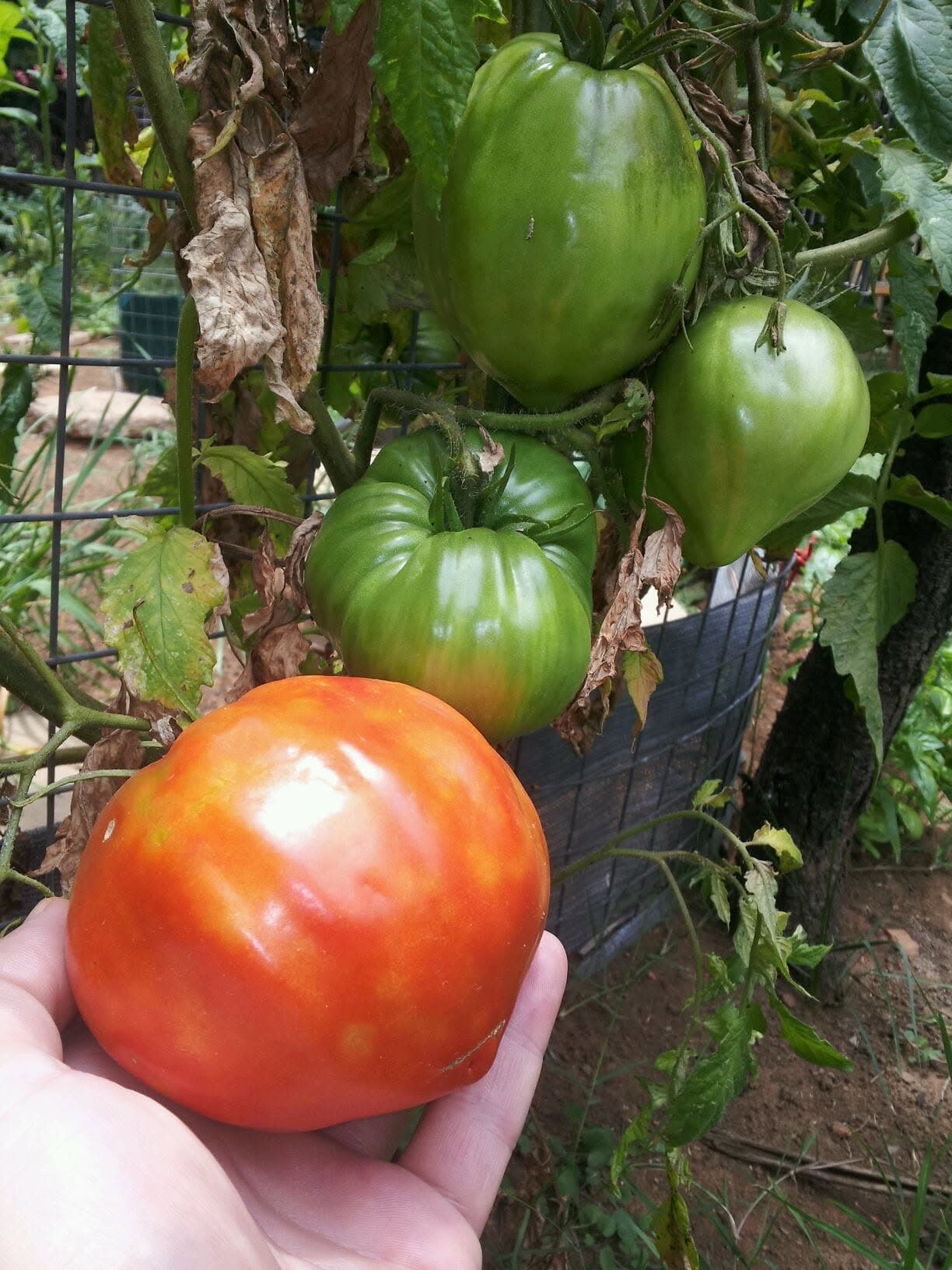
identifying featuresRipening on the plant: colour arrives fruit by fruit. 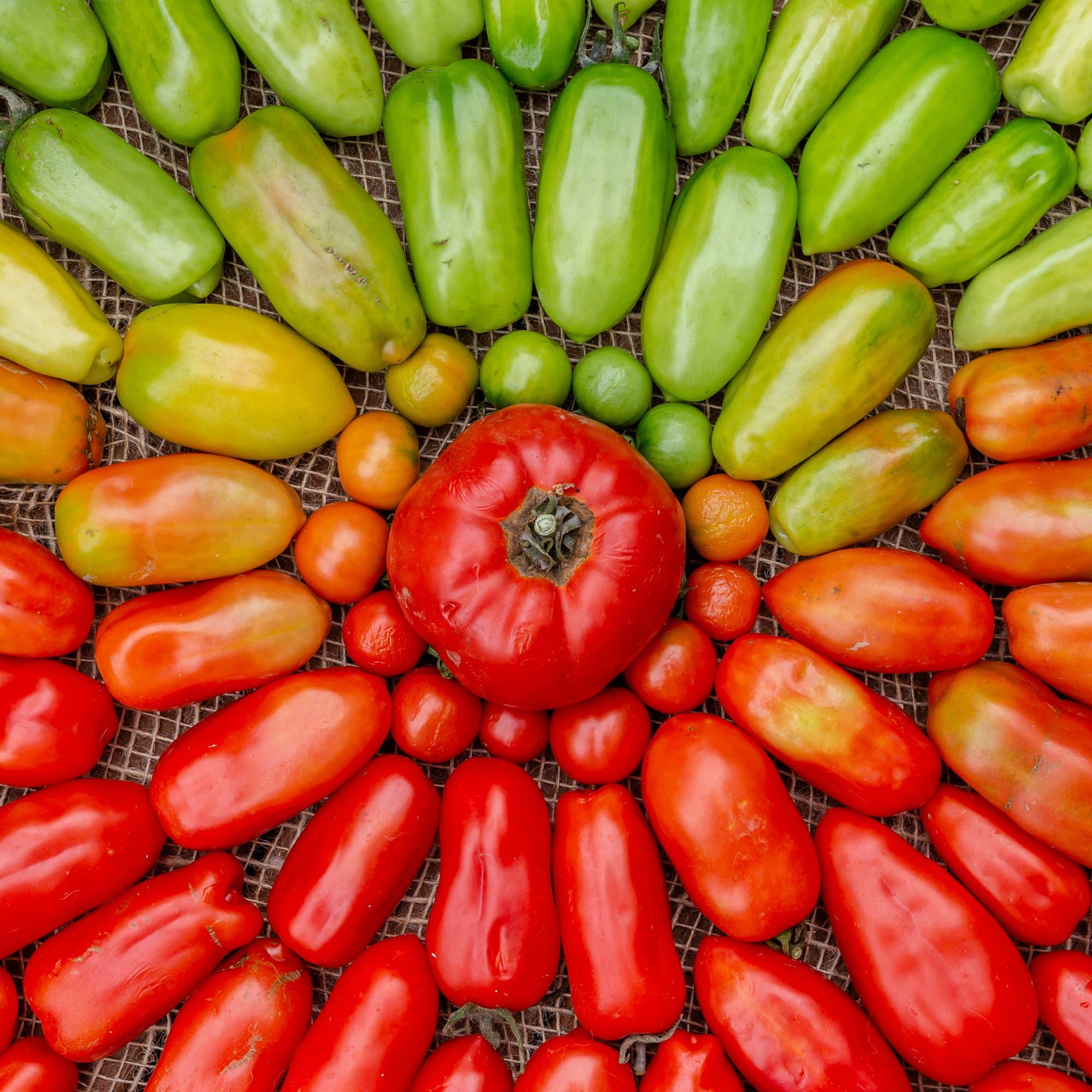
harvestedHarvested: from green to ripe, the whole run of colour on one tray.
- Growth habit
- A sprawling or vining plant, usually staked or caged, with soft hairy stems that branch freely and grow one to two metres in a season.
- Leaves
- Compound leaves with serrated, irregular leaflets, matt green and slightly hairy, with a strong green tomato smell when brushed.
- Stem
- Green, soft, hairy and easily bruised; older stems become tougher and ridged.
- Flower
- Small yellow star-shaped flowers in clusters, each becoming one fruit.
- Colour
- Fruit starts green and ripens through yellow-orange to red on most varieties; some varieties stay yellow, orange or purple-black.
- Aroma
- The foliage and calyx carry the sharp, resinous tomato-leaf smell; ripe fruit smells sweet and faintly grassy.
- Texture
- Smooth, thin skin over juicy flesh with seed cavities.
- Distinguishing features
- The clusters of yellow flowers, the hairy stem and the unmistakable smell of the leaves separate it from other garden plants.
- Common lookalikes
- Young plants resemble other nightshades such as potato or chilli; the flower colour and the smell of the leaves settle it.
CautionLeaves and stems are not eaten. Only ripe or deliberately used green fruit goes to the kitchen.
In the garden
Growing and harvest.
- Conditions
- Full sun, warm soil, regular water and support for the stems.
- Season
- A warm-season crop: sown after the last frost and fruiting through summer into early autumn. Seasons vary by region and climate.
- Harvested part
- The fruit.
- Ready when
- Full colour for the variety, a slight give under the thumb and easy release from the stem.
In the kitchen
Flavour and use.
- Flavour
- Sweet, acidic and deeply savoury, more so when cooked down.
- Aroma
- Fresh and grassy raw; rich and jammy once reduced.
- Texture
- Juicy flesh, firm walls, soft seeds in gel.
- Edible parts
- The fruit, raw or cooked, with or without skin and seeds. Leaves and stems are not eaten.
- Preparations
- Sliced raw with salt and oil, Blanched and peeled, Slow-roasted, Reduced to sauce or passata, Oven-dried, Fermented or preserved in jars
- Techniques
- Roasting, Slow reduction, Blanching and peeling, Drying, Fermenting, Preserving
- Pairs with
- Basil, Olive oil, Garlic, Mozzarella, Anchovy, Bread
- How Paul uses it
- Fermented tomatoes are part of Paul's pantry, as photographed on the Private Hospitality page: whole tomatoes put up in jars, labelled by hand and dated.
Selection and storage
Choosing, keeping, preserving.
- Choosing
- Heavy for their size, smooth and unbroken skin, fragrant at the stem end. Colour should be even for the variety.
- Storage
- Keep at room temperature away from direct sun and use within a few days; refrigeration dulls flavour and texture, though it slows spoilage once fully ripe.
- Preserving
- Sauces and passata bottled hot, oven-dried halves in oil, whole fruit fermented in brine.
Traditional uses, nutrition and current evidence
What is known, and how well.
Each statement carries its evidence level in words and a numbered source. Nothing here recommends an ingredient as a treatment.
Nutrition
Traditional use
Traditional use, not clinically established
A staple of Mediterranean cooking since the eighteenth century, valued in traditional diets as an everyday fruit-vegetable rather than for any particular remedy. [1]
Current evidence
Early or limited evidence
Population studies and some trials associate higher tomato and lycopene intake with modestly better markers of cardiovascular health, but the evidence is mixed and does not show that tomatoes prevent or treat disease. [3]
Safety and cautions
Before you cook with it.
- Allergy to tomato exists and can appear as itching of the mouth in people sensitised to grass or birch pollen; anyone with a known reaction should avoid it.
- Unripe green tomatoes and the leaves and stems contain the glycoalkaloid tomatine. Ripe fruit contains very little; green tomatoes are eaten in modest culinary amounts, while leaves and stems are not eaten.
- Its acidity can aggravate reflux for some people.
- These notes concern the fruit as food. Concentrated lycopene supplements are a different matter and are not covered here.
This ingredient profile is provided for culinary and general educational purposes. It is not medical advice and does not recommend an ingredient as a treatment. Anyone who is pregnant, managing a medical condition, allergic, or taking medication should consult an appropriate healthcare professional before using concentrated herbal preparations or supplements.
Elsewhere on DUKAI
Also in the library
Sources and review
- 1USDA FoodData Central, Tomatoes, red, ripe, raw, year round averageNational food-composition database
- 2National Institutes of Health, Office of Dietary Supplements, Vitamin C fact sheetGovernment health agency
- 3Cheng HM, Koutsidis G, Lodge JK, Ashor A, Siervo M, Lara J. Tomato and lycopene supplementation and cardiovascular risk factors: a systematic review and meta-analysis. Atherosclerosis. 2017;257:100-108.Peer-reviewed systematic review and meta-analysis
- 4Friedman M. Tomato glycoalkaloids: role in the plant and in the diet. Journal of Agricultural and Food Chemistry. 2002;50(21):5751-5780.Peer-reviewed review
Sources reviewed 9 September 2026. Culinary and general educational information.
Photograph credits
- Organic home-grown tomatoes - unripe to ripe.jpg by Michal Klajban, CC BY-SA 4.0, via Wikimedia Commons. Resized for the web; otherwise unaltered.
The remaining photographs are from Paul Dukai's own archive.