Butternut squash
Cucurbita moschata
A pale, bell-shaped winter squash with dense orange flesh that roasts sweet and keeps for months in a cool room.
- Also
- Butternut, Butternut pumpkin
- Family
- Cucurbitaceae (gourd family)
How to recognise it
In the garden and in the hand.
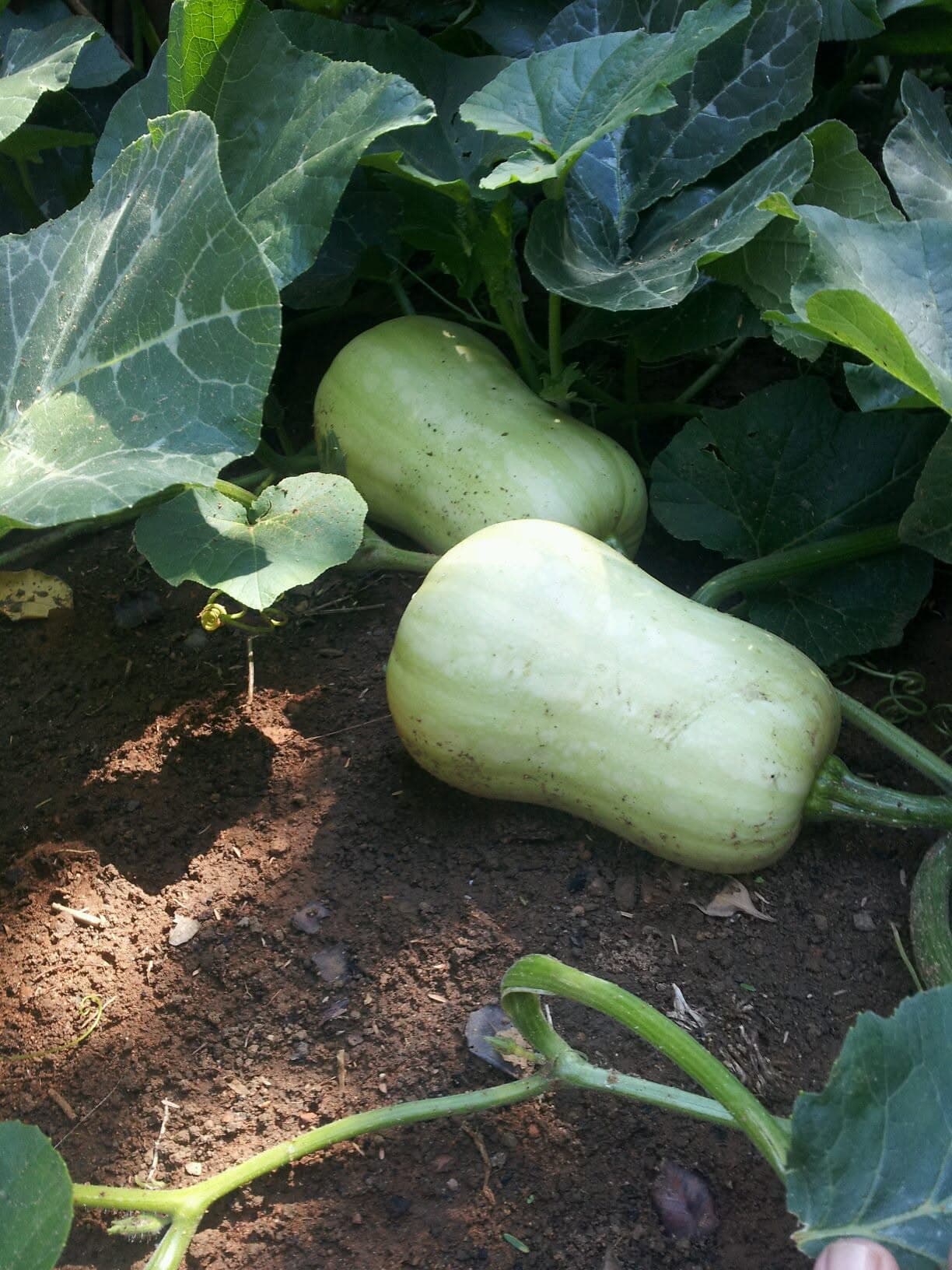
growingOn the vine: pale green fruit under large rough leaves. 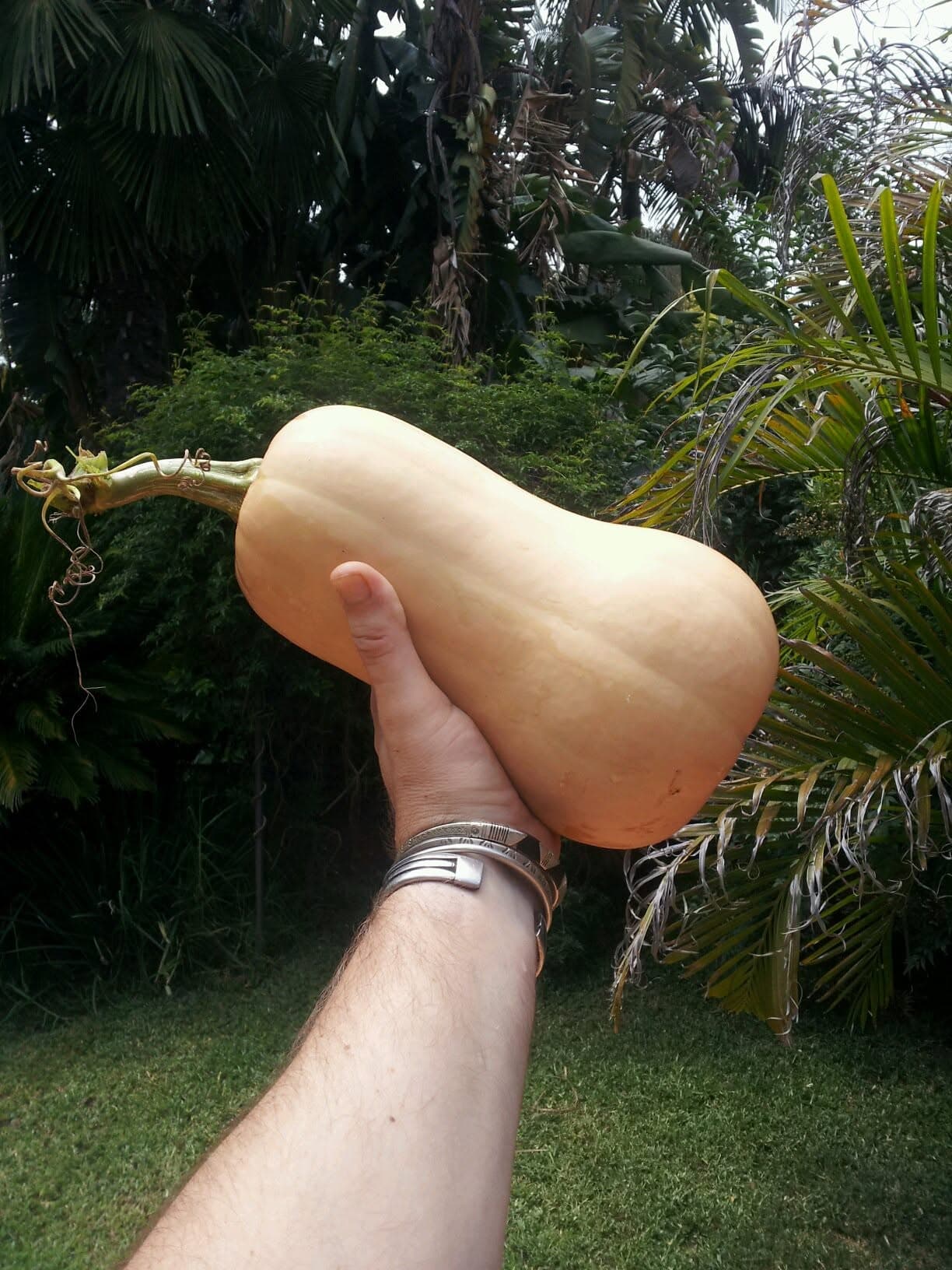
harvestedHarvested: even tan skin, hard rind, dry corky stem.
- Growth habit
- A vigorous trailing vine with large rough leaves that runs several metres along the ground.
- Leaves
- Large, broad, shallowly lobed leaves with a rough, slightly prickly surface, on long hollow stalks.
- Stem
- Long, ridged, hairy runners with coiling tendrils.
- Flower
- Large yellow-orange trumpet flowers; female flowers carry a tiny swelling fruit behind them.
- Colour
- The fruit is pale green with faint stripes while growing and turns an even tan when ripe.
- Aroma
- Faint, sweet and vegetal when cut.
- Texture
- Hard smooth rind, dense fibrous orange flesh, a seed cavity in the bulb.
- Distinguishing features
- The elongated neck and bulbous base, the smooth tan skin and the five-sided, flared stem.
- Common lookalikes
- Other Cucurbita moschata squashes and some gourds look similar while green; the ripe tan colour and bell shape are the guide.
In the garden
Growing and harvest.
- Conditions
- Full sun, rich soil, room to run and steady water while the fruit sets.
- Season
- Sown in spring, harvested in late summer and autumn, then cured and stored. Seasons vary by region and climate.
- Harvested part
- The mature fruit.
- Ready when
- Even tan skin, a hard rind the thumbnail cannot dent, and a dry, corky stem.
In the kitchen
Flavour and use.
- Flavour
- Sweet, nutty and mild, deepening with roasting.
- Texture
- Dense and smooth when cooked; velvety in soups.
- Edible parts
- The flesh; the skin softens enough to eat when roasted; the seeds can be toasted.
- Preparations
- Roasted in wedges, Puréed for soup, Diced for risotto or pasta filling, Grated raw into salads
- Techniques
- Roasting, Steaming, Puréeing, Braising
- Pairs with
- Sage, Brown butter, Parmesan, Chilli, Cinnamon and nutmeg, Blue cheese
Selection and storage
Choosing, keeping, preserving.
- Choosing
- Heavy for its size, matte skin without soft spots, stem intact and dry.
- Storage
- Whole, in a cool dry room for weeks to months; once cut, wrap and refrigerate and use within a few days.
- Preserving
- Roasted purée freezes well; cubes can be blanched and frozen.
Traditional uses, nutrition and current evidence
What is known, and how well.
Each statement carries its evidence level in words and a numbered source. Nothing here recommends an ingredient as a treatment.
Nutrition
Traditional use
Traditional use, not clinically established
A storage crop across the Americas and Africa, valued for keeping through winter; no particular remedial use is claimed. [1]
Current evidence
Supported by human research
Provitamin A carotenoids from foods are converted to vitamin A, which the body needs for normal vision and immune function; this is the established role of the nutrient, not a claim that squash treats any condition. [2]
Safety and cautions
Before you cook with it.
- Eaten as food it is safe for most people.
- Handling large quantities of raw squash can irritate the skin of some people's hands; wash after cutting.
- Very large intakes of carotenoid-rich foods can tint the skin yellow-orange, which is harmless and reverses when intake falls.
This ingredient profile is provided for culinary and general educational purposes. It is not medical advice and does not recommend an ingredient as a treatment. Anyone who is pregnant, managing a medical condition, allergic, or taking medication should consult an appropriate healthcare professional before using concentrated herbal preparations or supplements.
Sources and review
- 1USDA FoodData Central, Squash, winter, butternut, rawNational food-composition database
- 2National Institutes of Health, Office of Dietary Supplements, Vitamin A and Carotenoids fact sheetGovernment health agency
Sources reviewed 9 September 2026. Culinary and general educational information.
Photographs are from Paul Dukai's own archive.