Carrot
Daucus carota subsp. sativus
The sweet orange root at the base of stocks, braises and roasting trays, at its best pulled young from loose soil.
- Also
- Carrots, Carota
- Family
- Apiaceae (carrot family)
How to recognise it
In the garden and in the hand.
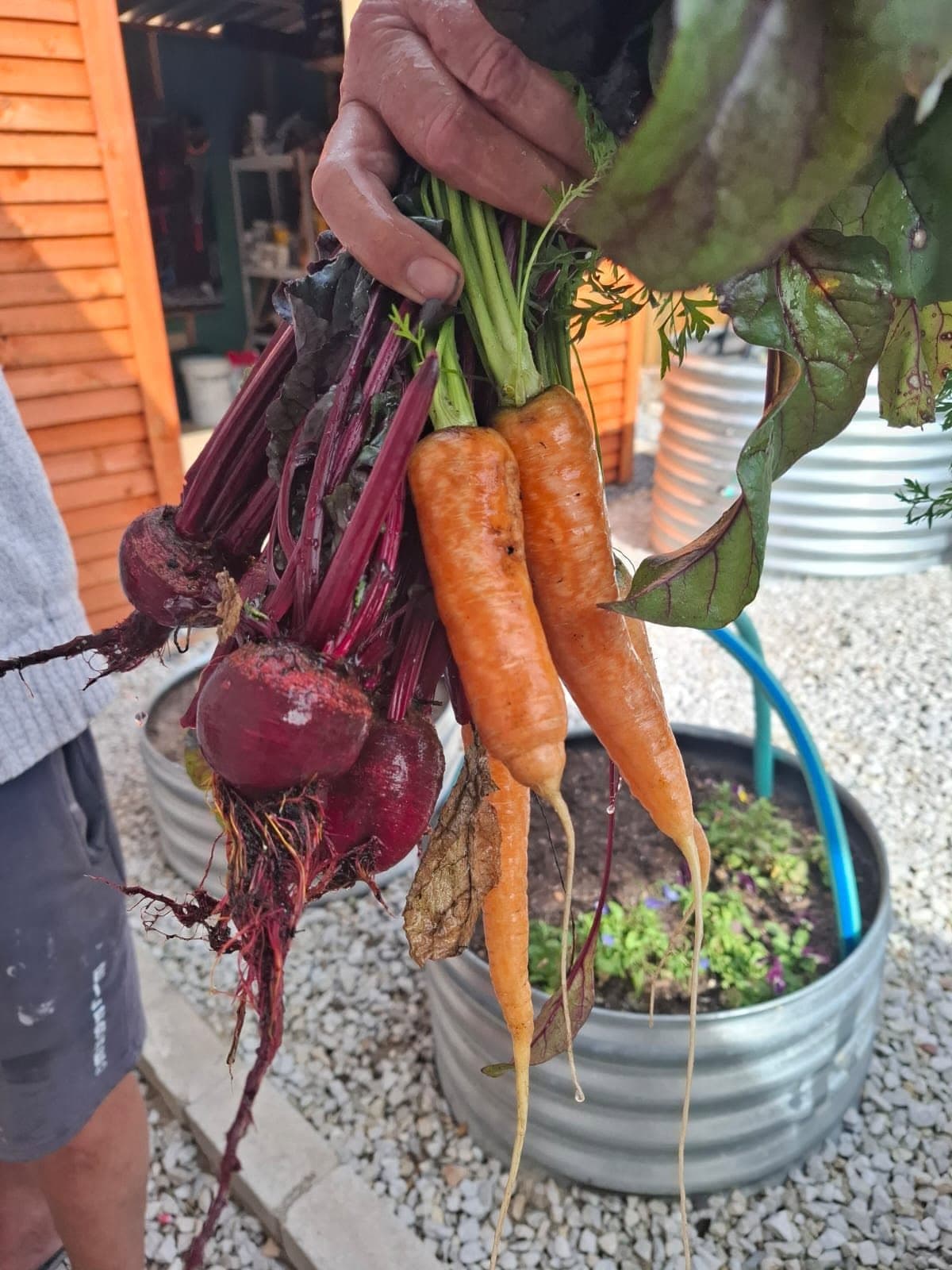
harvestedHarvested: orange taproots with feathery tops, straight from the soil.
- Growth habit
- A rosette of feathery leaves above a single tapering taproot; in its second year it sends up a tall flower stem.
- Leaves
- Finely divided, feathery, fern-like leaves on slender stalks, smelling of carrot when crushed.
- Stem
- Leaf stalks only in the first year; a ribbed, branching flower stem up to a metre in the second.
- Flower
- Flat white umbels, like lace, only if the plant is left to bolt.
- Colour
- Orange roots on most varieties; purple, yellow and white varieties exist.
- Aroma
- Clean, sweet and earthy, strongest in the leaves when crushed.
- Texture
- Crisp, dense root.
- Distinguishing features
- The feathery foliage smelling of carrot above an orange taproot.
- Common lookalikes
- The foliage resembles other members of the carrot family, some of them poisonous (hemlock among them). A photograph of the leaves is not enough to identify a wild plant; in the garden, identity comes from the sown seed and the root.
CautionNever eat a wild plant on the strength of carrot-like leaves.
In the garden
Growing and harvest.
- Conditions
- Deep, loose, stone-free soil, full sun and even moisture; thin the seedlings so the roots can swell.
- Season
- Sown in succession from early spring to late summer in temperate gardens, harvested two to four months later. Seasons vary by region and climate.
- Harvested part
- The taproot; the young leaves can be used sparingly.
- Ready when
- The shoulder of the root shows at the soil surface at the width you want; pull one to check.
In the kitchen
Flavour and use.
- Flavour
- Sweet and earthy, sweeter when roasted or slowly braised.
- Texture
- Crisp raw; tender and yielding when cooked.
- Edible parts
- The root, raw or cooked; the leaves in small amounts.
- Preparations
- Grated raw, Diced for soffritto and stocks, Roasted whole, Glazed, Puréed
- Techniques
- Roasting, Braising, Glazing, Puréeing, Pickling
- Pairs with
- Cumin, Orange, Butter, Honey, Coriander, Yoghurt
- How Paul uses it
- A baby carrot with purée and jus sits beside the duck on the Canadian High Commissioner chapter, one of the three plated dishes photographed there.
Selection and storage
Choosing, keeping, preserving.
- Choosing
- Firm, smooth, bright roots that snap cleanly; fresh green tops if attached.
- Storage
- Remove the tops, which draw moisture from the root, and refrigerate in a bag for two to three weeks.
- Preserving
- Pickled, fermented in brine, or blanched and frozen.
Traditional uses, nutrition and current evidence
What is known, and how well.
Each statement carries its evidence level in words and a numbered source. Nothing here recommends an ingredient as a treatment.
Nutrition
Traditional use
Traditional use, not clinically established
Grown for the root since at least the tenth century, and long associated in folk belief with eyesight; the true relationship is the vitamin A role described below. [2]
Current evidence
Supported by human research
The body converts beta-carotene from foods to vitamin A, which is required for normal vision and immune function. Eating carrots supports adequate vitamin A intake; it does not improve eyesight beyond normal. [2]
Safety and cautions
Before you cook with it.
- Carrot can cause allergic reactions, often as itching of the mouth in people sensitised to birch pollen; anyone with a known reaction should avoid it.
- Very large intakes of carotene-rich foods tint the skin yellow-orange (carotenaemia), which is harmless and fades when intake falls.
- The feathery leaves resemble poisonous relatives in the wild; identification by leaves alone is unsafe.
This ingredient profile is provided for culinary and general educational purposes. It is not medical advice and does not recommend an ingredient as a treatment. Anyone who is pregnant, managing a medical condition, allergic, or taking medication should consult an appropriate healthcare professional before using concentrated herbal preparations or supplements.
Elsewhere on DUKAI
Also in the library
Sources and review
- 1USDA FoodData Central, Carrots, rawNational food-composition database
- 2National Institutes of Health, Office of Dietary Supplements, Vitamin A and Carotenoids fact sheetGovernment health agency
- 3Ballmer-Weber BK, Wuthrich B, Wangorsch A, Fotisch K, Altmann F, Vieths S. Carrot allergy: double-blinded, placebo-controlled food challenge and identification of allergens. Journal of Allergy and Clinical Immunology. 2001;108(2):301-307.Peer-reviewed clinical study
Sources reviewed 9 September 2026. Culinary and general educational information.
Photographs are from Paul Dukai's own archive.