Garlic
Allium sativum
The bulb that starts most savoury cooking: pungent and sharp raw, sweet and mellow when roasted, and stored dry for months.
- Also
- Aglio
- Family
- Amaryllidaceae (onion family)
How to recognise it
In the garden and in the hand.
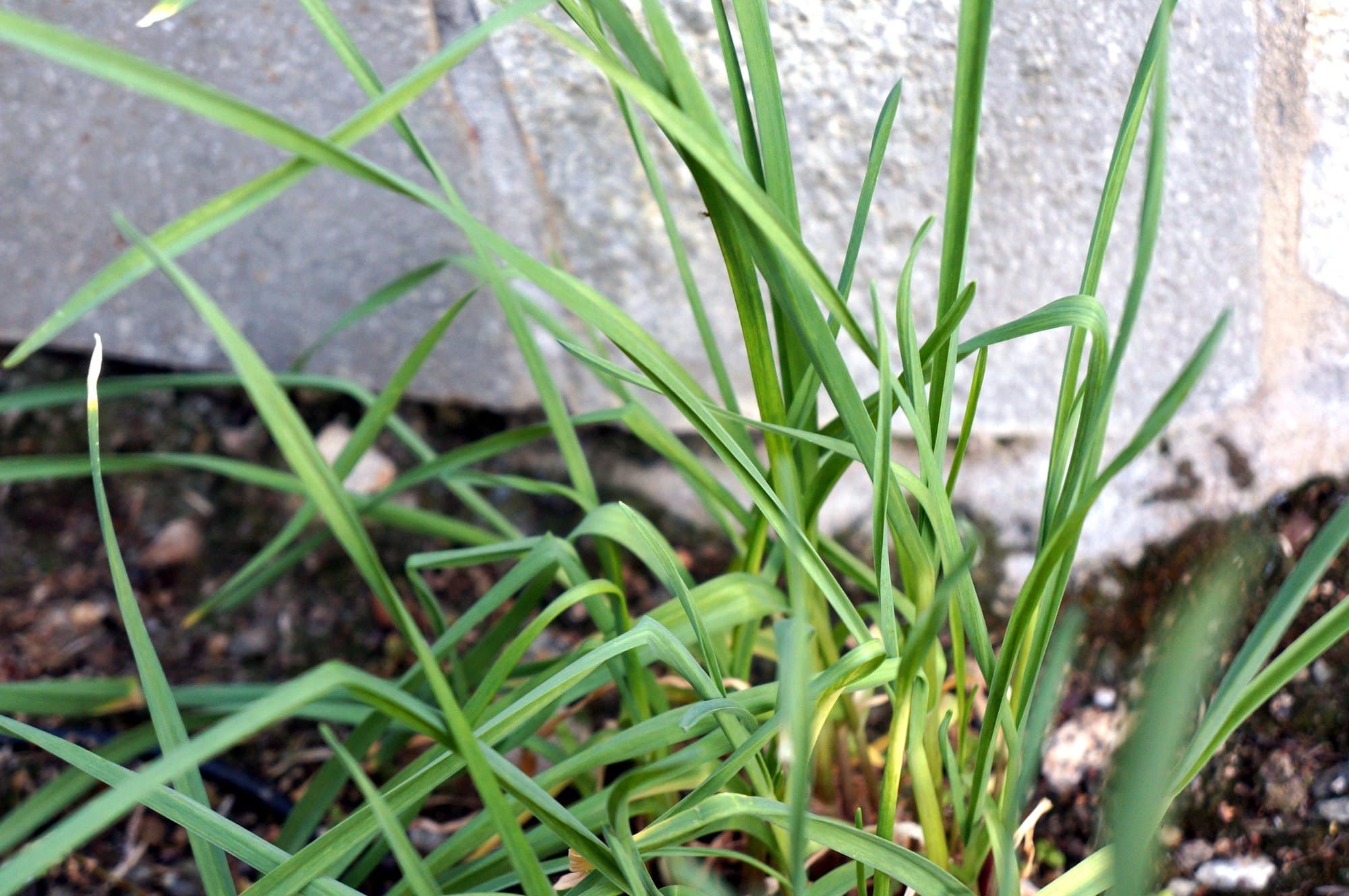
growingThe plant: flat, keeled, strap-like leaves in two ranks. 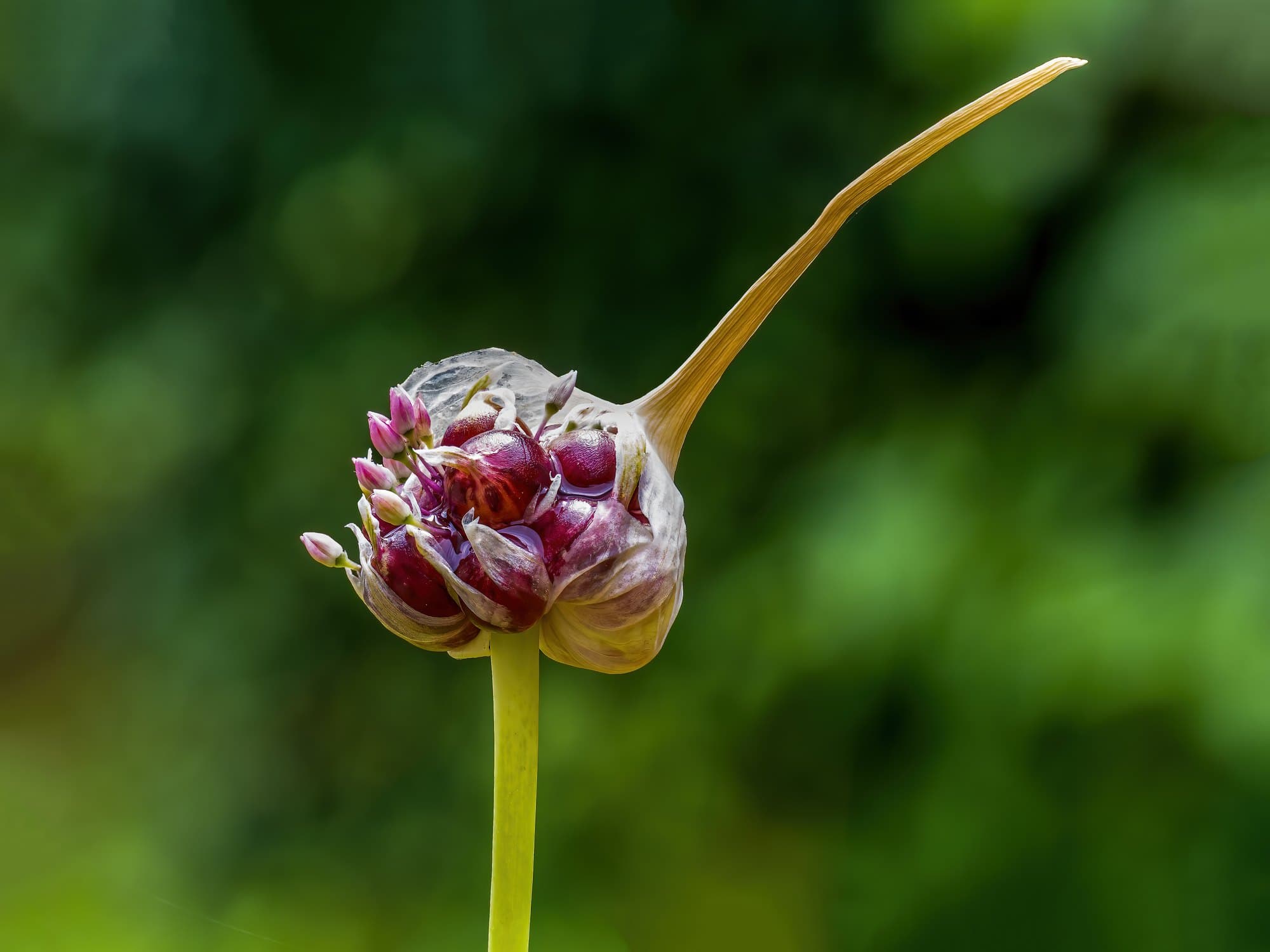
identifying featuresThe scape: a head of small flowers and bulbils on a curling stalk. 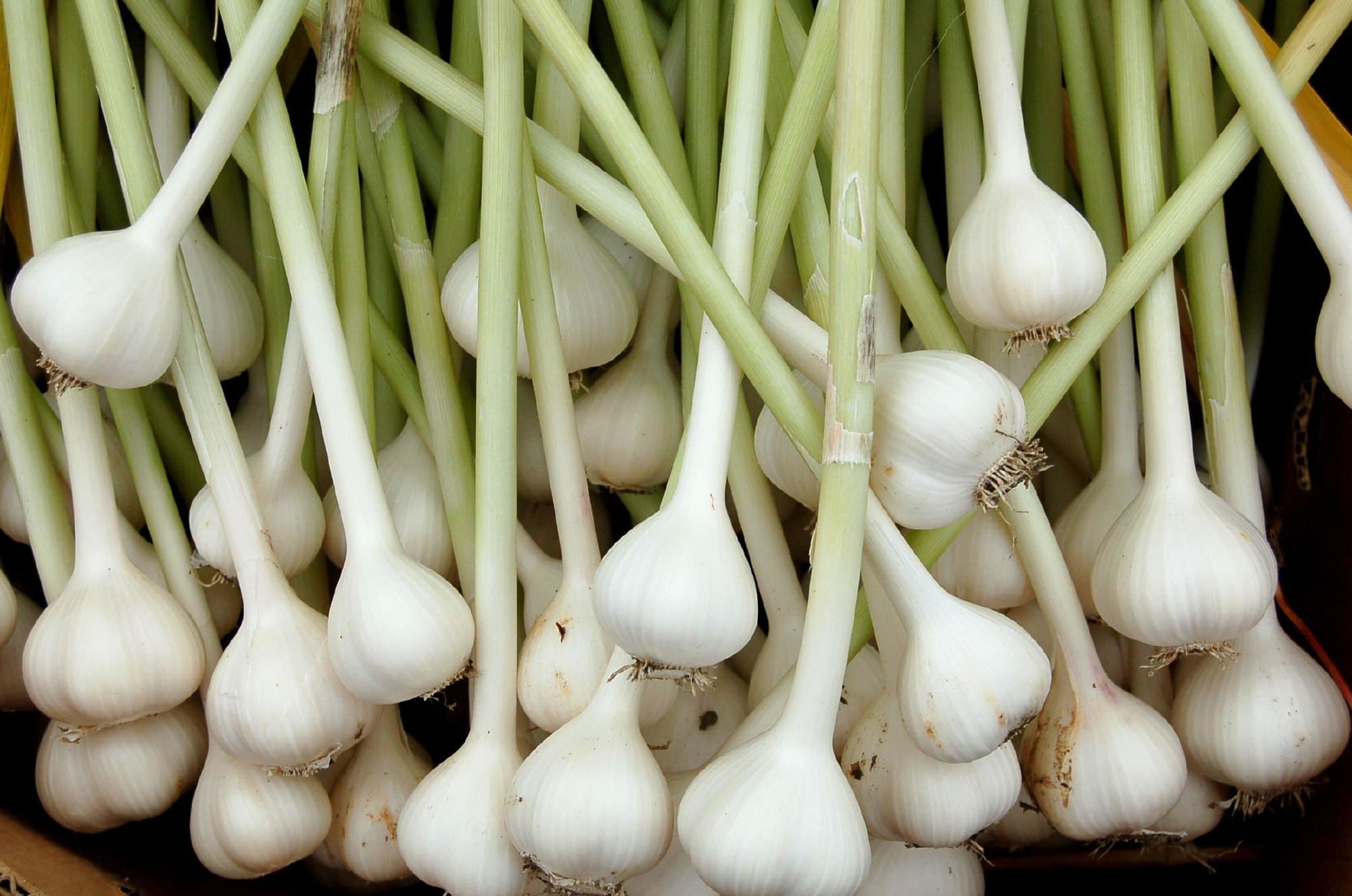
harvestedHarvested: whole plants lifted for curing, bulbs still attached to their stems. 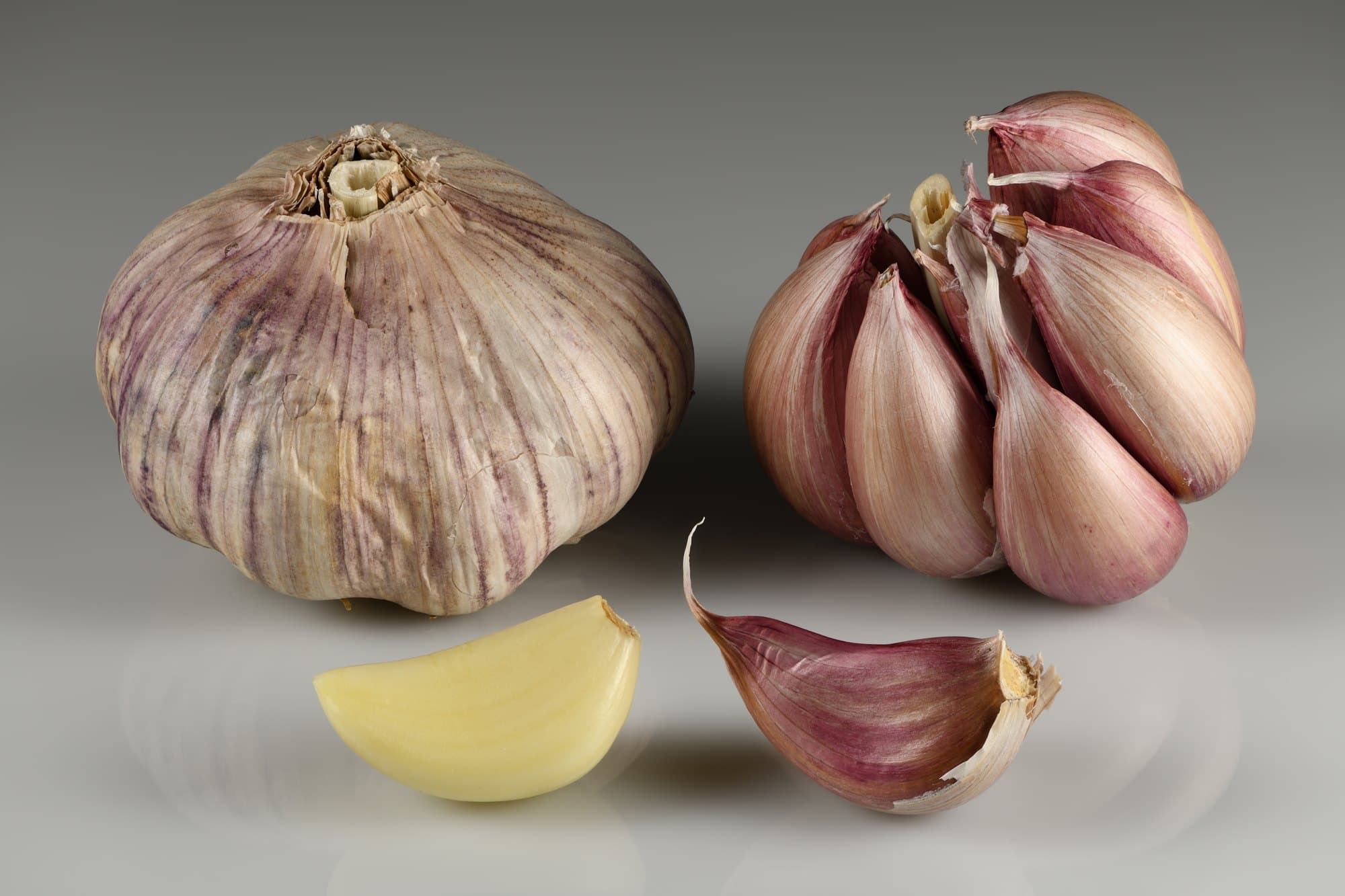
preparedIn the kitchen: the bulb, the papery skin, the clove.
- Growth habit
- An upright plant sixty to ninety centimetres high, with flat strap-like leaves rising from a single underground bulb; hardneck types send up a curling flower stalk in early summer.
- Leaves
- Long, flat, grey-green, keeled leaves, folded along the midrib, arranged in two ranks.
- Stem
- A false stem of sheathing leaf bases; hardneck varieties produce a stiff woody flower stalk (the scape) that coils before straightening.
- Flower
- A round head of small pale pink or white flowers mixed with tiny bulbils, on the scape, usually removed to strengthen the bulb.
- Colour
- White to purple-streaked papery skins over cream cloves.
- Aroma
- Sulphurous and sharp when crushed; the smell is the identifier.
- Texture
- Firm, crisp cloves under papery skin.
- Distinguishing features
- A bulb made of separate cloves wrapped in papery skin, flat keeled leaves, and the unmistakable smell.
- Common lookalikes
- In the garden, leeks and onions have similar leaves; onions form a single bulb without cloves. In the wild, garlic-scented leaves of ramsons (Allium ursinum) are edible, but poisonous lily of the valley and autumn crocus leaves grow in the same places and do not smell of garlic.
CautionNever eat a wild plant on leaf shape alone; if it does not smell of garlic when crushed, it is not garlic.
In the garden
Growing and harvest.
- Conditions
- Full sun, rich, well-drained soil; planted as single cloves in autumn or late winter, harvested when the lower leaves yellow.
- Season
- Green garlic and scapes in spring; mature bulbs lifted in early summer, then cured and stored. Seasons vary by region and climate.
- Harvested part
- The bulb; also the green scapes and young whole plants.
- Ready when
- Lift when about a third of the leaves have yellowed; cure in a dry airy place for two to three weeks before storing.
In the kitchen
Flavour and use.
- Flavour
- Pungent and hot raw, sweet and nutty when roasted or slowly cooked; bitter if burnt.
- Aroma
- Sharp when raw and freshly cut; rounded and sweet once cooked.
- Texture
- Crisp raw; soft and creamy when roasted whole.
- Edible parts
- The cloves; the scapes; the leaves of young green garlic.
- Preparations
- Sliced or crushed into oil at the start of a dish, Roasted whole in the skin, Confited in oil, Pounded raw into aioli and pesto, Rubbed on grilled bread
- Techniques
- Sweating in oil, Roasting, Confit, Pounding, Infusing
- Pairs with
- Olive oil, Rosemary, Tomato, Lamb, Anchovy, Chilli
- How Paul uses it
- Garlic seasons the lamb in Agnello al rosmarino on the Recipes page and sits with the heirloom tomatoes and basil in the Portfolio photographs.
Selection and storage
Choosing, keeping, preserving.
- Choosing
- Firm, heavy heads with tight dry skins and no green shoots or soft cloves.
- Storage
- Whole heads in a cool, dry, airy place for months; not in the fridge, which encourages sprouting. Peeled or cut cloves in the fridge for a few days.
- Preserving
- Confit in oil and kept refrigerated, roasted and frozen, pickled, or fermented into black garlic. Home-made garlic in oil must be refrigerated and used within days (see safety).
Traditional uses, nutrition and current evidence
What is known, and how well.
Each statement carries its evidence level in words and a numbered source. Nothing here recommends an ingredient as a treatment.
Nutrition
Traditional use
Traditional use, not clinically established
The European Medicines Agency's herbal monograph records garlic bulb preparations as traditional herbal medicines for the relief of cold symptoms and as an adjunct to diet for the prevention of atherosclerosis. These are traditional-use registrations, not proof of efficacy. [3]
Current evidence
Supported by human research
Meta-analyses of randomised trials report that garlic supplements modestly lower blood pressure in people with hypertension and modestly lower total cholesterol. The trials used standardised supplements over weeks to months, not garlic in food, and the effects are small; garlic is not a treatment for either condition. [4] [5]
Safety and cautions
Before you cook with it.
- Garlic in food is safe for most people; large raw amounts can cause heartburn, wind and body odour.
- Garlic supplements can increase bleeding risk with anticoagulant and antiplatelet medicines and may interact with some HIV and other drugs; anyone on such medication should discuss supplements with their clinician. Ordinary culinary use is not the concern.
- Home-made garlic stored in oil at room temperature can support the growth of Clostridium botulinum, the cause of botulism. Keep garlic-in-oil refrigerated and use within a few days, or freeze it.
- Allergy to garlic exists and can also appear as contact dermatitis on the hands of cooks who handle it constantly.
This ingredient profile is provided for culinary and general educational purposes. It is not medical advice and does not recommend an ingredient as a treatment. Anyone who is pregnant, managing a medical condition, allergic, or taking medication should consult an appropriate healthcare professional before using concentrated herbal preparations or supplements.
Elsewhere on DUKAI
Also in the library
Sources and review
- 1USDA FoodData Central, Garlic, rawNational food-composition database
- 2National Institutes of Health, Office of Dietary Supplements, Vitamin C fact sheetGovernment health agency
- 3European Medicines Agency, Committee on Herbal Medicinal Products. European Union herbal monograph on Allium sativum L., bulbus (EMA/HMPC/7686/2013), 2017.Medicines regulator
- 4Ried K. Garlic lowers blood pressure in hypertensive individuals, regulates serum cholesterol, and stimulates immunity: an updated meta-analysis and review. Journal of Nutrition. 2016;146(2):389S-396S.Peer-reviewed meta-analysis
- 5National Center for Complementary and Integrative Health (NIH). Garlic: usefulness and safety.Government health agency
Sources reviewed 9 September 2026. Culinary and general educational information.
Photograph credits
- Allium sativum 1 2014-03-26.jpg by FASTILY, CC BY-SA 3.0, via Wikimedia Commons. Resized for the web; otherwise unaltered.
- Knoblauch Blüte focus stack-20250713-RM-111019.jpg by Reinhold Möller (Ermell), CC BY-SA 4.0, via Wikimedia Commons. Resized for the web; otherwise unaltered.
- Garlic organically grown.jpg by Jennifer Dickert, CC BY 2.0, via Wikimedia Commons. Resized for the web; otherwise unaltered.
- Garlic bulbs and cloves.jpg by Ivar Leidus, CC BY-SA 4.0, via Wikimedia Commons. Resized for the web; otherwise unaltered.