Rosemary
Salvia rosmarinus (formerly Rosmarinus officinalis)
Needle-leaved, piney and robust: the evergreen of roast potatoes, lamb and focaccia, and a shrub that thrives on neglect.
- Also
- Rosmarino
- Family
- Lamiaceae (mint family)
How to recognise it
In the garden and in the hand.
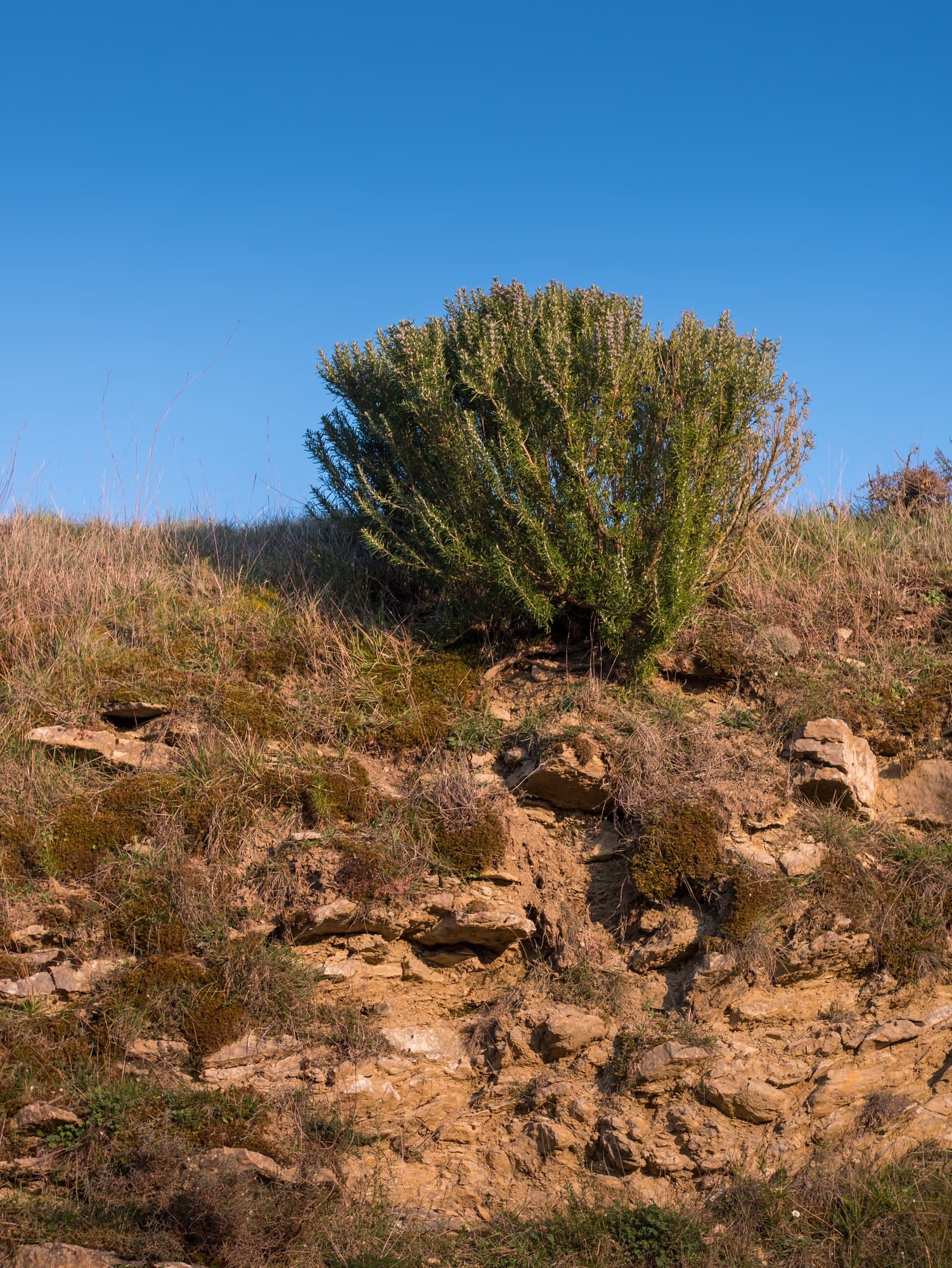
growingThe shrub: dense, evergreen, at home on a dry rocky slope. Former quarry at Olarizu, Vitoria, Spain. 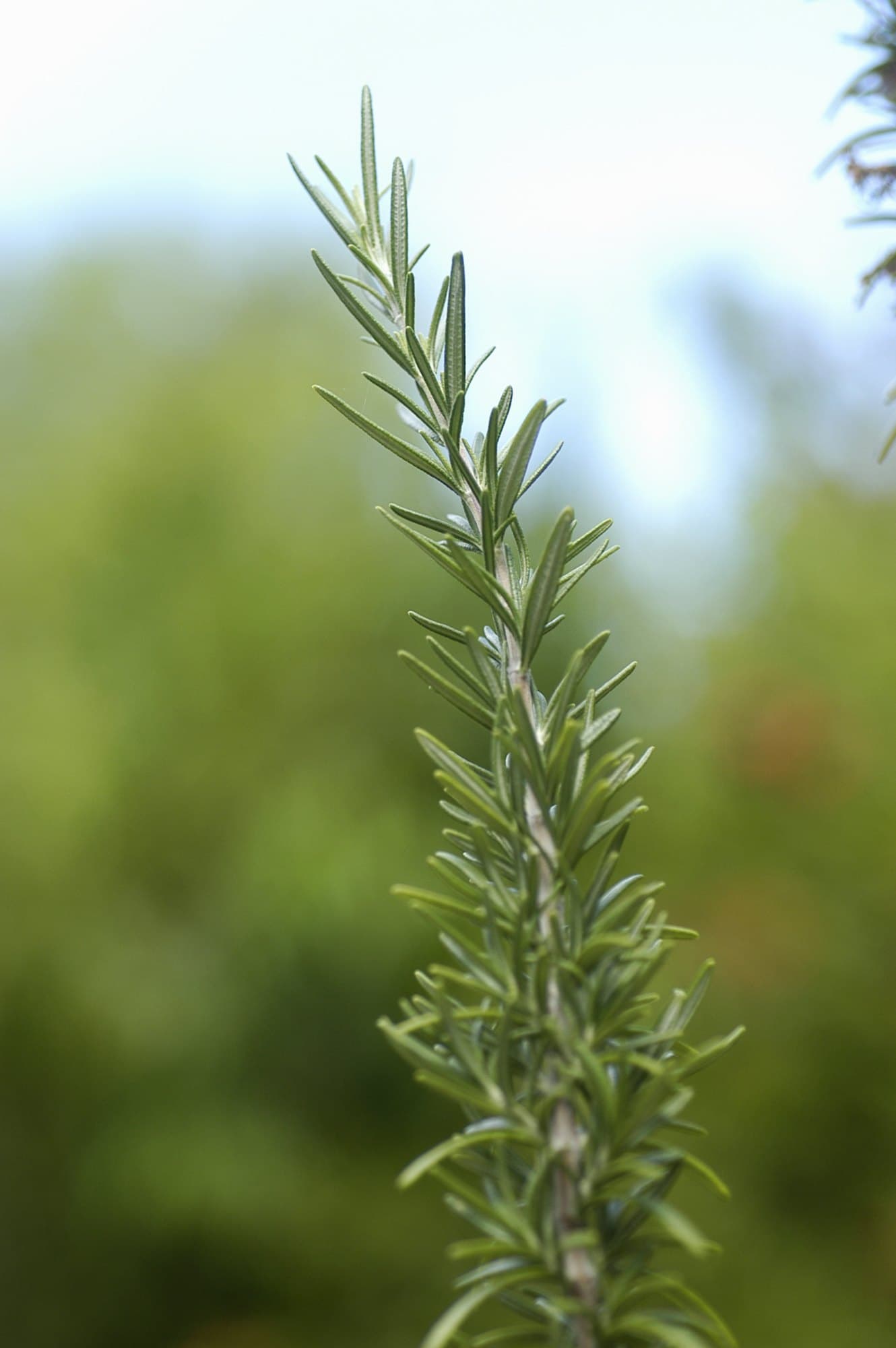
identifying featuresLeaves: narrow needles crowded along the stem, green above and pale beneath. 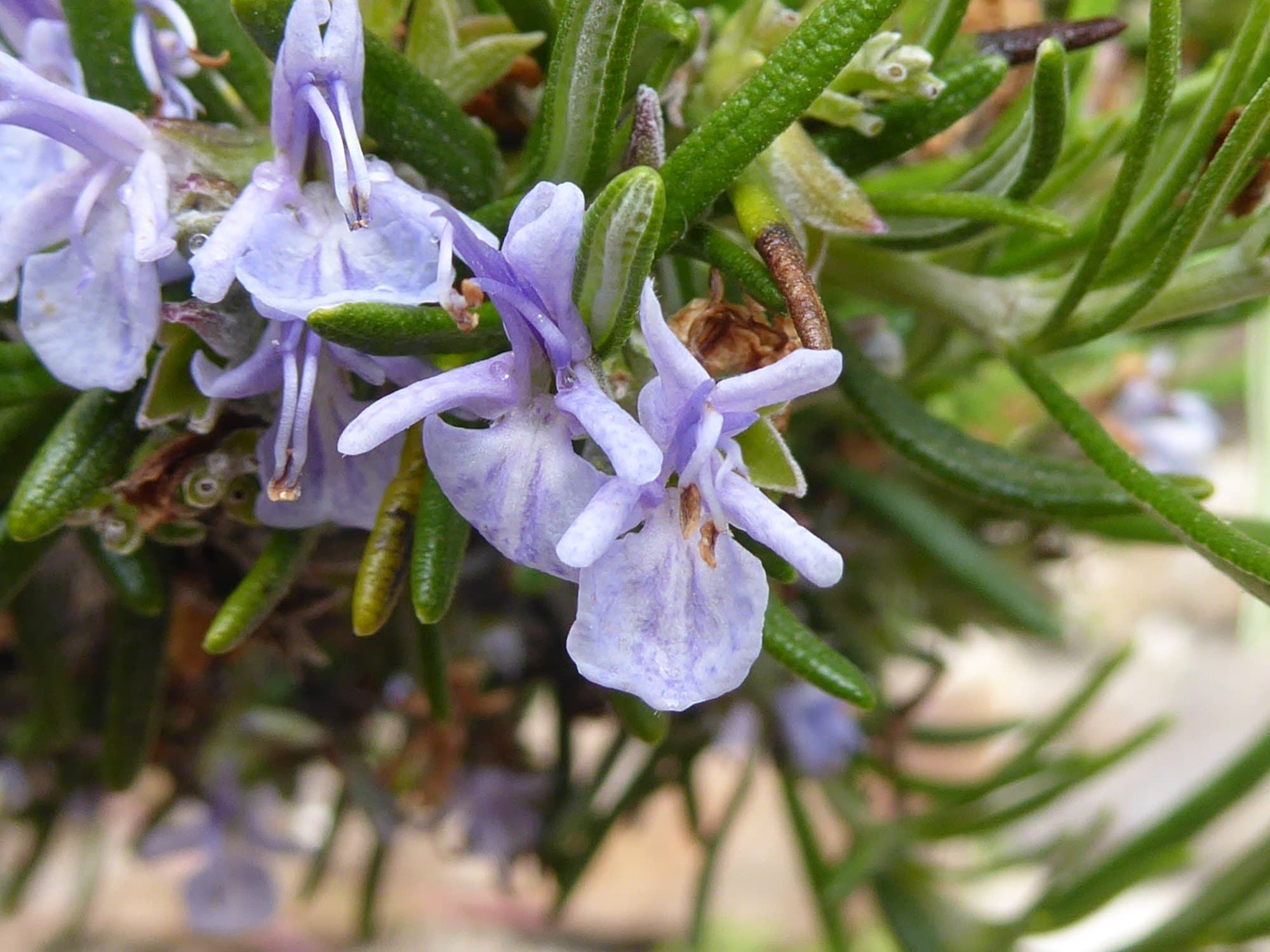
identifying featuresFlowers: pale lilac-blue, two-lipped, clustered along the stems. Segonzano, Italy. 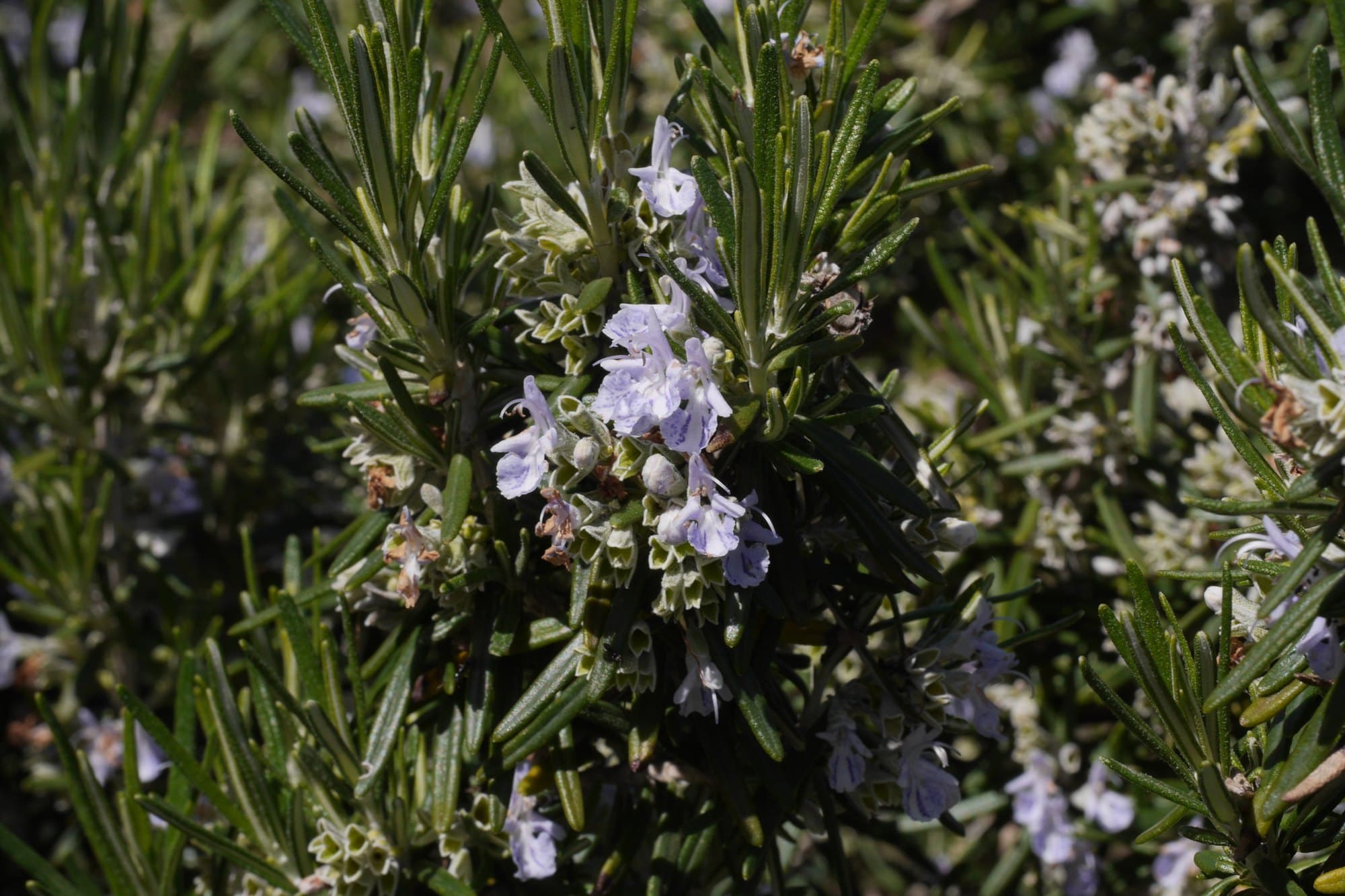
harvestedA sprig in flower, as it would be cut for the kitchen.
- Growth habit
- A dense evergreen shrub, one to two metres high, upright or sprawling depending on the variety; grows wild on dry Mediterranean hillsides.
- Leaves
- Narrow, needle-like leaves two to four centimetres long, dark green and leathery above, white and felted beneath, with edges rolled under; crowded along the stems.
- Stem
- Woody, brown and rough with age; young shoots square and downy.
- Flower
- Small two-lipped flowers, pale blue to lilac (occasionally white or pink), in clusters along the stems, mainly in winter and spring but sporadically all year.
- Colour
- Dark green needles with silvery undersides.
- Aroma
- Piney, resinous and camphorous; the scent rises from the plant on a warm day.
- Texture
- Stiff, leathery needles; tender only at the growing tips.
- Distinguishing features
- Needle leaves that are green above and white-felted beneath, on a woody aromatic shrub, with lilac-blue flowers along the stems.
- Common lookalikes
- Lavender has grey needle-like leaves but a sweet floral scent and flowers on bare stalks. Young pine or fir shoots lack the felted underside and the culinary scent.
CautionIdentify by the felted white underside and the resinous scent together.
In the garden
Growing and harvest.
- Conditions
- Full sun, sharp drainage, lean soil and little water once established; frost-hardy varieties exist, but wet cold kills it.
- Season
- Evergreen and pickable all year; new growth in spring is the most tender. Seasons vary by region and climate.
- Harvested part
- Sprigs and leaves; woody stems can be used as skewers.
- Ready when
- Cut from established plants, never more than a third at a time; the plant resents hard pruning into old wood.
In the kitchen
Flavour and use.
- Flavour
- Piney, resinous, warm and slightly bitter; strong enough to dominate if overused.
- Aroma
- Intense; carries through roasting and grilling.
- Texture
- Needles stay tough unless finely chopped or removed before serving.
- Edible parts
- The leaves; the flowers as a garnish.
- Preparations
- Whole sprigs in the roasting tin, Finely chopped into bread and focaccia dough, Infused into oil, butter or syrup, Stems as skewers, Tied into a bouquet garni
- Techniques
- Roasting, Grilling, Infusing, Baking
- Pairs with
- Lamb, Potatoes, Garlic, Olive oil, White beans, Lemon
- How Paul uses it
- Agnello al rosmarino, lamb with rosemary, garlic and jus, sits on the Recipes page, and a sprig appears in the photographs on the Portfolio and Philosophy pages.
Selection and storage
Choosing, keeping, preserving.
- Choosing
- Pliable green sprigs with a strong scent and no dry, brown needles.
- Storage
- Wrap in damp paper in the fridge for two weeks or more; it is one of the hardiest herbs.
- Preserving
- Dries well; also freezes on the sprig, or in oil. Dried rosemary is harder and sharper than fresh, so use less and chop finely.
Traditional uses, nutrition and current evidence
What is known, and how well.
Each statement carries its evidence level in words and a numbered source. Nothing here recommends an ingredient as a treatment.
Nutrition
Established nutritional fact
Rosemary is used in small amounts; per serving it contributes negligible energy. It is a source of aromatic compounds rather than nutrients. [1]
Traditional use
Traditional use, not clinically established
The European Medicines Agency's herbal monograph records rosemary leaf as a traditional herbal medicine for mild digestive complaints and, applied externally, for minor muscular and joint pain and poor circulation. These are traditional-use registrations, not proof of efficacy. [2]
Current evidence
Early or limited evidence
Rosemary extract (E 392) is an approved antioxidant food additive in the European Union, on the basis of its ability to slow fat oxidation in foods; that is a food-technology use, not a health effect from eating the herb. [3]
Safety and cautions
Before you cook with it.
- Culinary quantities of rosemary are safe for most people.
- Rosemary essential oil is a concentrated preparation and is not for internal use; the EMA monograph limits its external use and does not recommend concentrated rosemary preparations in pregnancy, while breastfeeding or for children.
- Rosemary contains camphor; large amounts of the concentrated oil can be toxic. This does not apply to the herb used in cooking.
- Allergic contact dermatitis from rosemary has been reported in a small number of people who handle it often.
This ingredient profile is provided for culinary and general educational purposes. It is not medical advice and does not recommend an ingredient as a treatment. Anyone who is pregnant, managing a medical condition, allergic, or taking medication should consult an appropriate healthcare professional before using concentrated herbal preparations or supplements.
Elsewhere on DUKAI
Also in the library
Sources and review
- 1USDA FoodData Central, Spices, rosemary, freshNational food-composition database
- 2European Medicines Agency, Committee on Herbal Medicinal Products. Community herbal monograph on Rosmarinus officinalis L., folium (EMA/HMPC/13631/2009), 2010, and on Rosmarinus officinalis L., aetheroleum (EMA/HMPC/235453/2009).Medicines regulator
- 3European Food Safety Authority, Panel on Food Additives. Use of rosemary extracts as a food additive: scientific opinion. EFSA Journal. 2008;6(3):721.Food-safety regulator
Sources reviewed 9 September 2026. Culinary and general educational information.
Photograph credits
- Vitoria - Olarizu - Cantera - Romero 01.jpg by Basotxerri, CC BY-SA 4.0, via Wikimedia Commons. Resized for the web; otherwise unaltered.
- AlecrimDSC5074.jpg by CostaPPPR, CC BY-SA 4.0, via Wikimedia Commons. Resized for the web; otherwise unaltered.
- Rosmarinus officinalis flowers 02.jpg by Syrio, CC BY-SA 4.0, via Wikimedia Commons. Resized for the web; otherwise unaltered.
- Salvia rosmarinus 267146015.jpg by Nico, CC0, via Wikimedia Commons. Resized for the web; otherwise unaltered.