Octopus
Octopus vulgaris (common octopus) and related species
Eight-armed, tender only when treated with patience: simmered slowly, then charred over coals, it is one of the great dishes of the Mediterranean coast.
- Also
- Polpo, Polipo, Pulpo
- Family
- Octopodidae
How to recognise it
In the garden and in the hand.
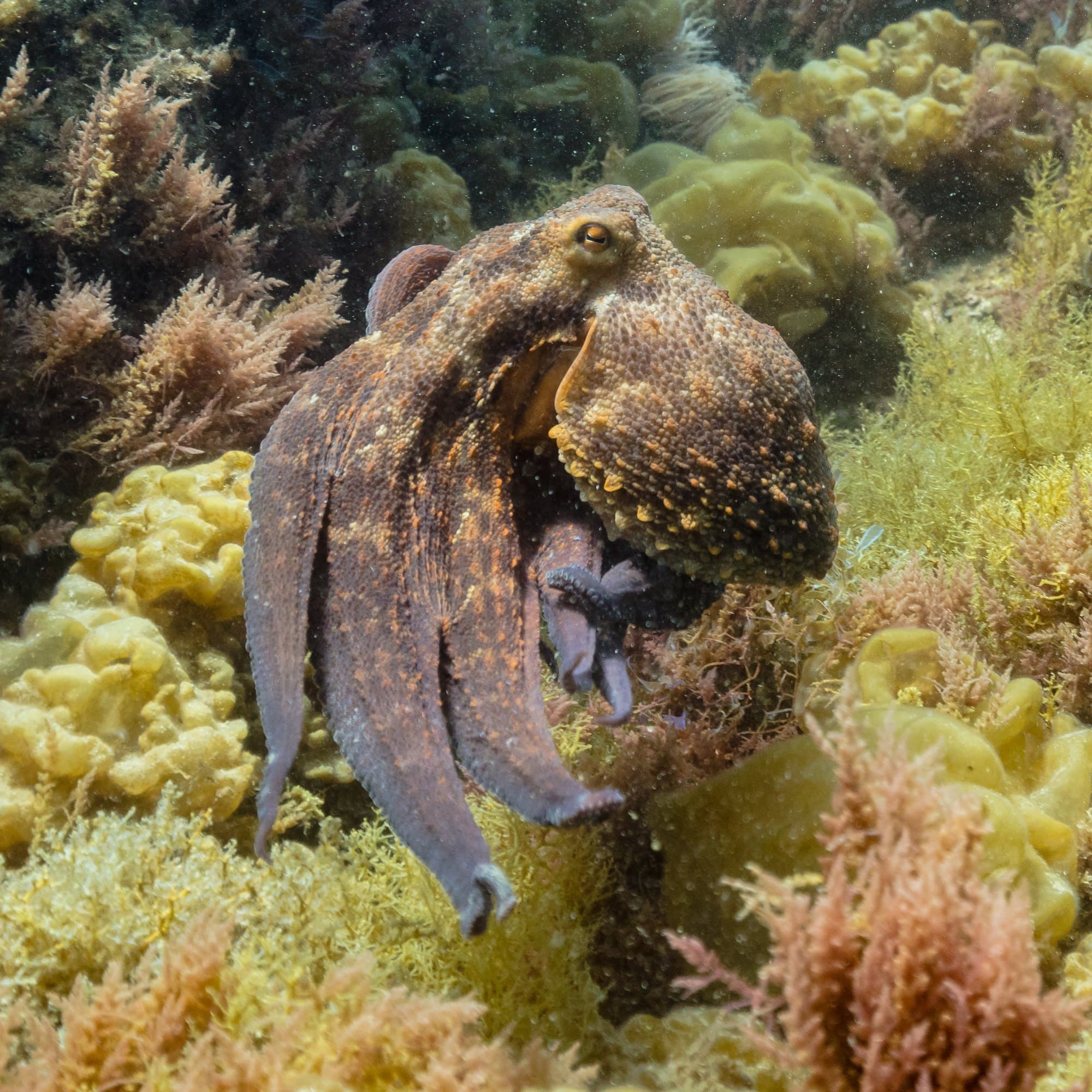
growingAlive: the common octopus, Octopus vulgaris, on a reef in the Arrábida Natural Park, Portugal. 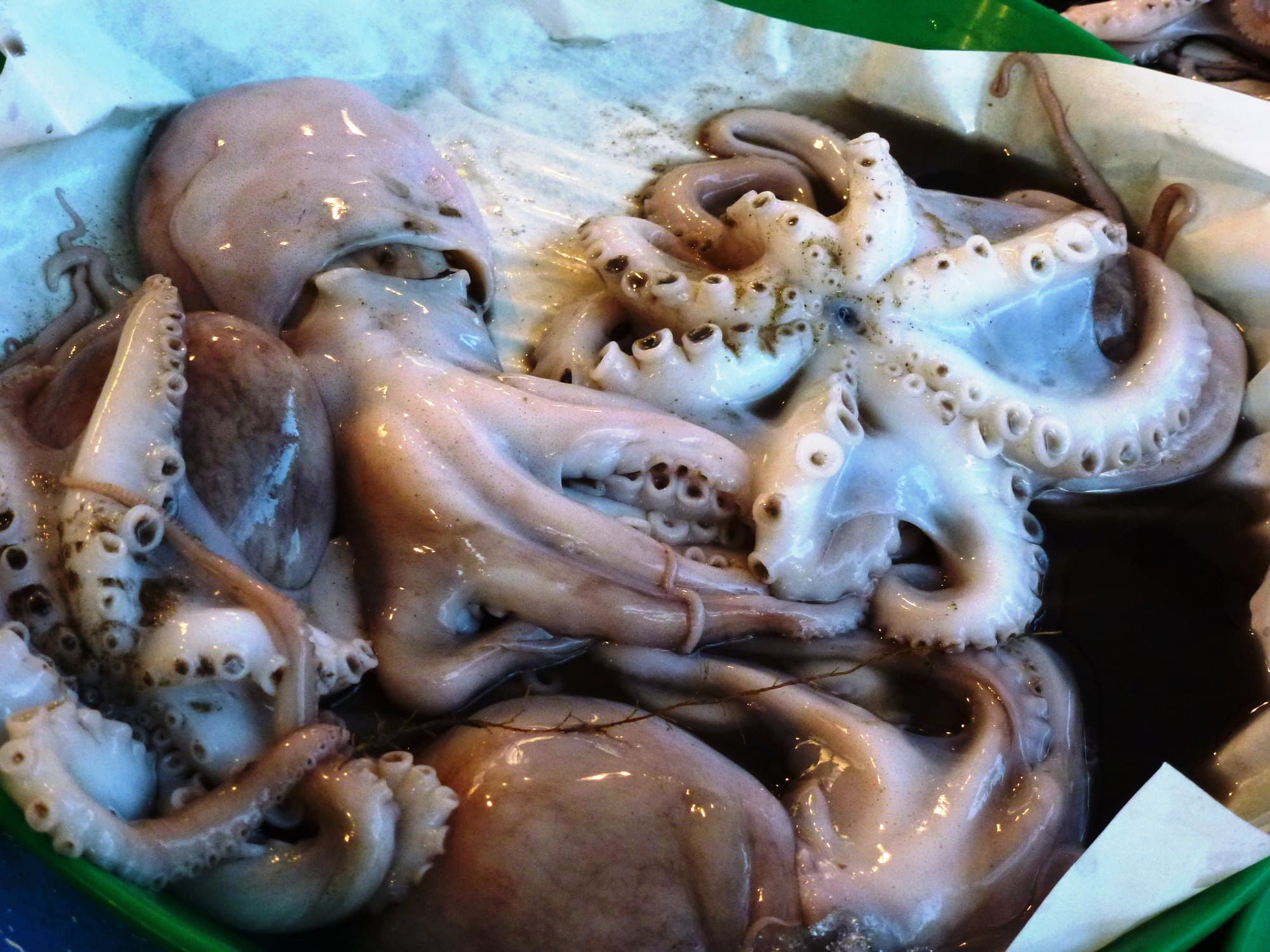
harvestedAt market: whole, raw, the two rows of suckers along each arm. Marché de la Bastille, Paris. 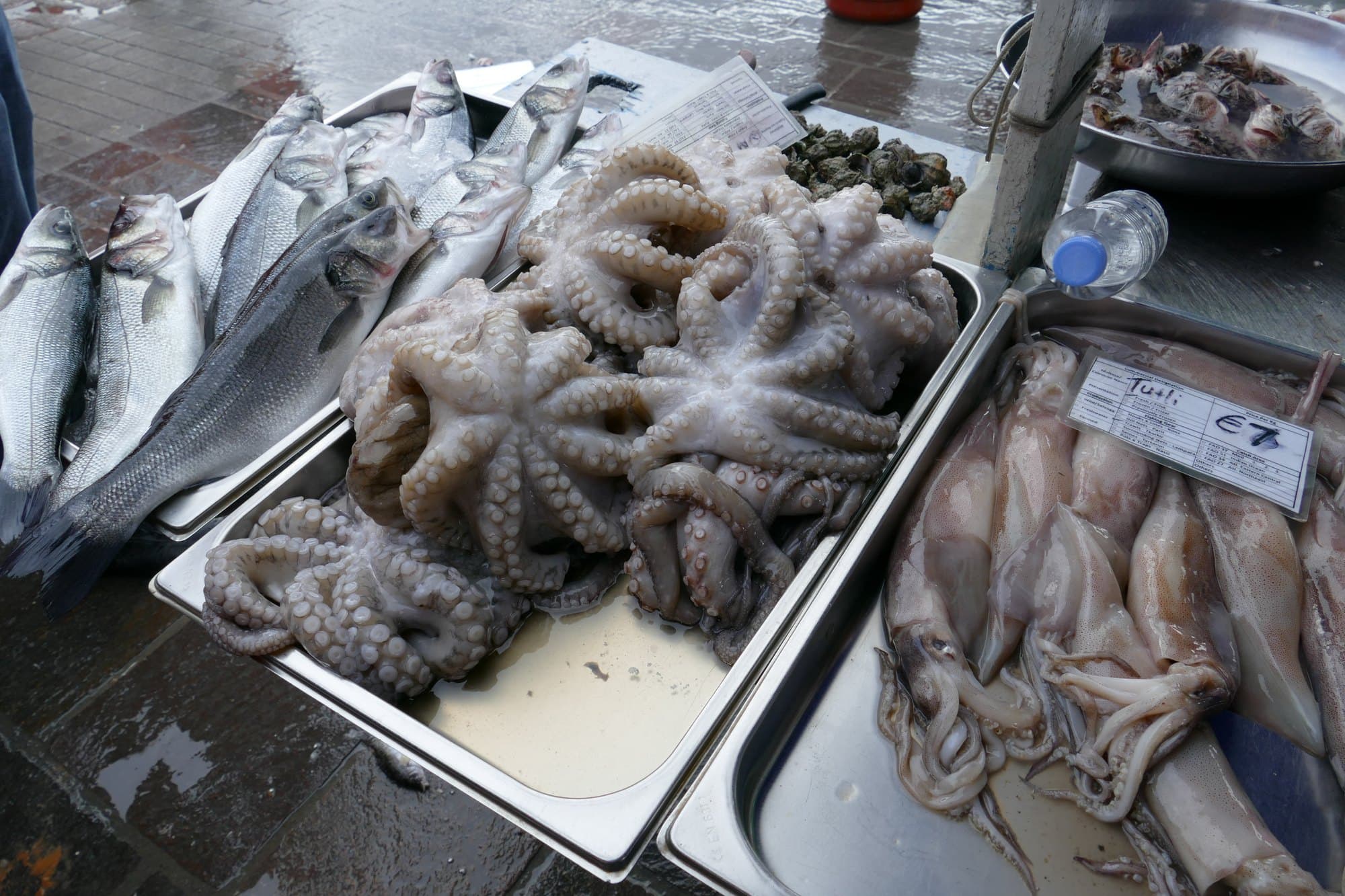
harvestedOn ice: whole octopus at the Marsaxlokk market, Malta. 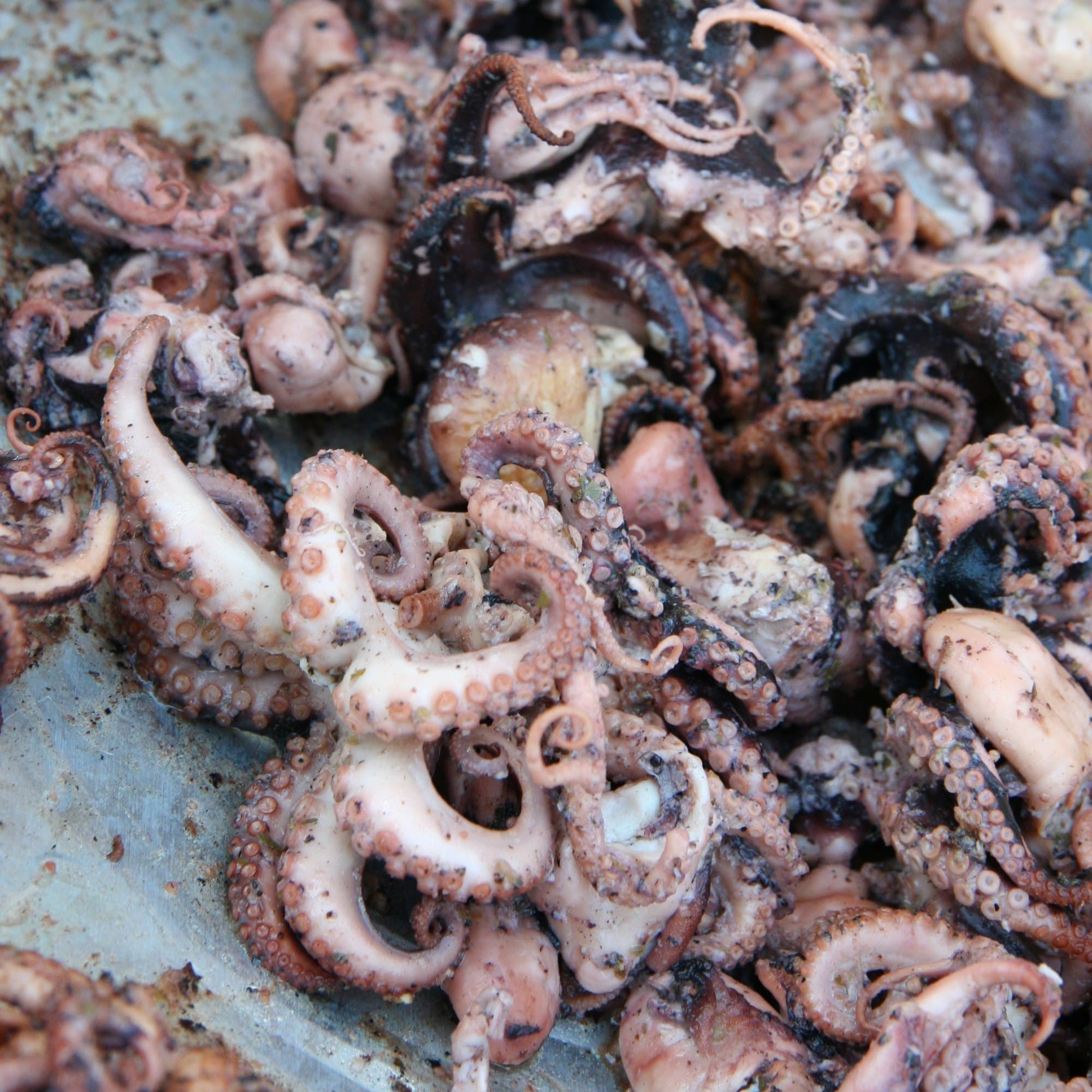
preparedGrilled: simmered first, then charred.
- Growth habit
- A soft-bodied mollusc without a shell: a rounded head and body (the mantle) with eight arms, each carrying two rows of suckers. The common octopus reaches a metre or more across the arms.
- Colour
- Changes at will from mottled brown and grey to reddish or almost white; at market, dull grey-brown to purplish.
- Aroma
- Clean and of the sea when fresh; never ammoniac.
- Texture
- Firm, dense muscle; the skin slightly slippery.
- Distinguishing features
- Eight arms with two rows of suckers, no fins, and a bag-like body; squid and cuttlefish have ten appendages, fins and an internal shell or bone.
- Common lookalikes
- Small squid and cuttlefish are sometimes sold alongside; count the arms and look for fins. Several octopus species reach market under the same name, and the catalogue or fishmonger should say which.
CautionOnly the blue-ringed octopuses of the Indo-Pacific are dangerously venomous, and they are not sold as food. Species identity at market is a question for the supplier.
In the garden
Growing and harvest.
- Conditions
- Wild-caught from rocky coasts and reefs in temperate and tropical seas, by pot, trap and line; some species are farmed experimentally. South Africa has a small managed octopus fishery.
- Season
- Available frozen year round; fresh landings vary by region and fishery rules. Seasons vary by region and climate.
- Harvested part
- The whole animal: arms, mantle and head, after the beak, eyes and innards are removed.
- Ready when
- Quality at market: bright skin, intact suckers, a clean smell and firm flesh. Frozen octopus is often preferred, as freezing tenderises it.
In the kitchen
Flavour and use.
- Flavour
- Sweet, mild and briny, with a savoury depth once charred.
- Aroma
- Clean and marine when raw; smoky and rich from the grill.
- Texture
- Tough if rushed; tender and yielding after a slow simmer; crisp-edged after charring.
- Edible parts
- Arms and mantle; the head once cleaned. Beak, eyes and innards are discarded.
- Preparations
- Simmered slowly until tender, then charred on the grill, Braised in wine and tomato, Boiled and dressed with olive oil, lemon and potato (Galician style), Pressed and sliced thin as carpaccio
- Techniques
- Simmering, Grilling over coals, Braising, Pressing and slicing, Freezing to tenderise
- Pairs with
- Olive oil, Lemon, Chickpeas, Potato, Paprika, Parsley and garlic
- How Paul uses it
- Polpo alla griglia, charred octopus with chickpeas, preserved lemon and herbs, is on the Recipes page, and Paul's Training page mentions fish and seafood among the subjects taught.
Selection and storage
Choosing, keeping, preserving.
- Choosing
- Bright, unbroken skin, suckers intact, eyes clear if the head is present, a clean sea smell. Buy from a supplier who can name the species and origin.
- Storage
- Fresh, on ice in the coldest part of the fridge and used within a day or two; frozen, for months.
- Preserving
- Freezing is the usual method and improves tenderness; cooked octopus keeps two days refrigerated and can be preserved under oil for a short time.
Traditional uses, nutrition and current evidence
What is known, and how well.
Each statement carries its evidence level in words and a numbered source. Nothing here recommends an ingredient as a treatment.
Nutrition
Established nutritional fact
Octopus is lean, high in protein and low in fat, and provides iron, selenium, vitamin B12 and copper. [1]
Traditional use
Traditional use, not clinically established
Fished and eaten around the Mediterranean since antiquity, and dried, boiled or grilled across coastal cultures from Portugal to Japan; no remedial use is claimed. [2]
Current evidence
No health-related research claim is made for this ingredient.
Safety and cautions
Before you cook with it.
- Octopus is a mollusc; people with shellfish allergy, including to squid, mussels or prawns, may react to it. Tropomyosin is the main shared allergen.
- Cook thoroughly. Raw or undercooked seafood carries a risk of bacterial and parasitic infection; freezing and full cooking remove most of it.
- Octopus is moderately high in cholesterol and in sodium once salted or brined, which matters only to people who have been advised to limit them.
- Buy from a supplier who can state species and origin; the profile makes no claim about the sustainability of any particular fishery.
This ingredient profile is provided for culinary and general educational purposes. It is not medical advice and does not recommend an ingredient as a treatment. Anyone who is pregnant, managing a medical condition, allergic, or taking medication should consult an appropriate healthcare professional before using concentrated herbal preparations or supplements.
Elsewhere on DUKAI
Also in the library
Sources and review
- 1USDA FoodData Central, Mollusks, octopus, common, rawNational food-composition database
- 2Jereb P, Roper CFE, Norman MD, Finn JK (eds). Cephalopods of the world: an annotated and illustrated catalogue of cephalopod species known to date. Volume 3, Octopods and vampire squids. FAO Species Catalogue for Fishery Purposes No. 4, Vol. 3. Rome: FAO; 2014.United Nations agency species catalogue
- 3Lopata AL, O'Hehir RE, Lehrer SB. Shellfish allergy. Clinical and Experimental Allergy. 2010;40(6):850-858.Peer-reviewed review
- 4United States Food and Drug Administration. Fish and Fishery Products Hazards and Controls Guidance, fourth edition, 2022.Food-safety regulator
Sources reviewed 9 September 2026. Culinary and general educational information.
Photograph credits
- Pulpo común (Octopus vulgaris), Parque natural de la Arrábida, Portugal, 2020-07-21, DD 33.jpg by Diego Delso, CC BY-SA 4.0, via Wikimedia Commons. Resized for the web; otherwise unaltered.
- Paris, des pieuvres au marché.JPG by Havang(nl), CC0, via Wikimedia Commons. Resized for the web; otherwise unaltered.
- Street market in Marsaxlokk 12.jpg by Kritzolina, CC BY-SA 4.0, via Wikimedia Commons. Resized for the web; otherwise unaltered.
- Octopi.jpg by Jonathunder, CC BY-SA 3.0, via Wikimedia Commons. Resized for the web; otherwise unaltered.